UNESCO recognizes Cyrus Cylinder as world symbol of human rights
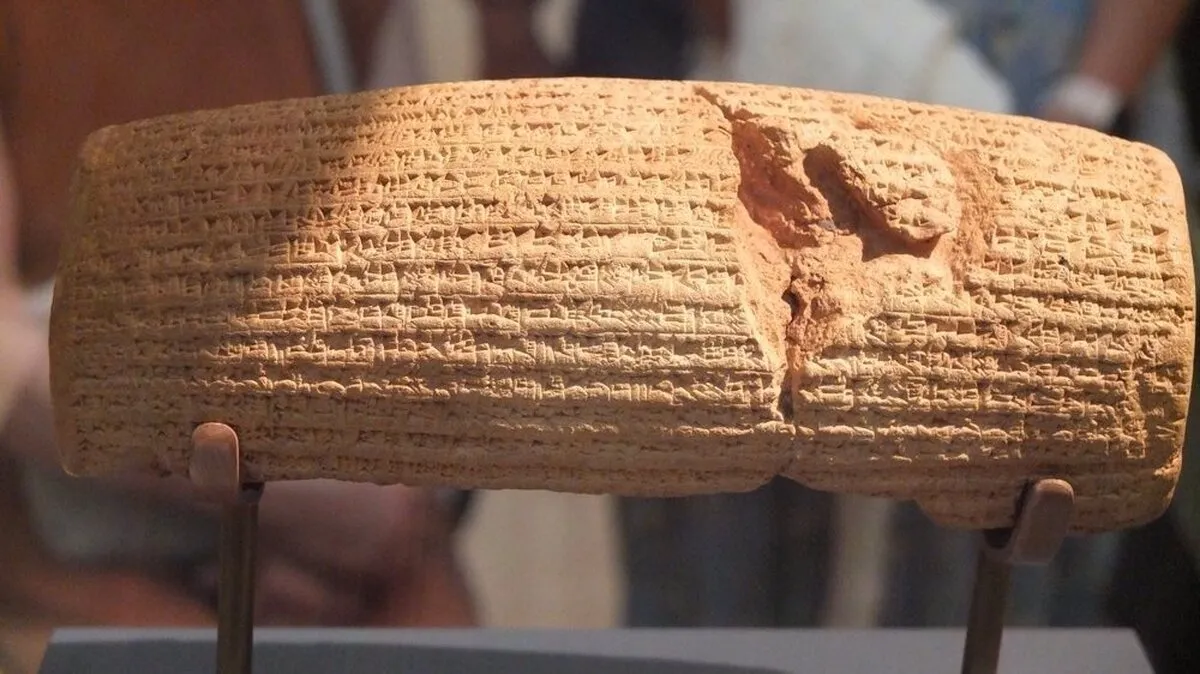
Tehran - BORNA - The decision was adopted unanimously by member states during the 43rd General Conference held in Samarkand, Uzbekistan, on November 6, 2025.
The resolution, jointly proposed by Iran, Tajikistan, and Iraq, identifies the Cyrus Cylinder as “a foundational document in the history of human civilization” and “the earliest written expression of the principles of liberty, justice, tolerance, and respect for cultural diversity.”
Under the new measure, UNESCO is tasked with promoting the teachings and values reflected in the artifact across its educational, cultural, and human rights programs.
Representatives from Egypt, Iraq, Colombia, India, Nigeria, Algeria, Pakistan, Bangladesh, Kenya, Senegal, Armenia, and Poland were among those who supported the initiative.
The Cyrus Cylinder, an ancient clay artifact housed at the British Museum, dates back to the 6th century BCE. It records the conquest of Babylon by Cyrus the Great and his policies of religious tolerance and restoration of sanctuaries.
Scholars have long viewed it as an early statement of governance based on justice and respect for human dignity — principles that have influenced both historical and modern discussions on human rights.
Iran has long held the banner of dialogue, tolerance: Minister
Iran’s Minister of Cultural Heritage, Tourism, and Handicrafts, Seyyed Reza Salehi-Amiri, hailed the adoption as “a sign of Iran’s role in shaping the universal concepts of justice, human dignity, and intercultural dialogue.”
In a message issued after the vote, he described the decision as “a lasting moment in the cultural memory of Iran and humanity.”
He added that UNESCO’s resolution portrays the Cyrus Cylinder as “a bridge between ethics and politics, between the past and the future, and between nations and the global conscience.”
Salehi-Amiri further noted that the text reminds the world that “freedom, respect for cultural diversity, reconstruction of communities and places of worship, and coexistence among religions have deep roots in Iran’s history.”
The Iranian civilization, he maintained, “has long carried the banner of dialogue, tolerance, justice, and spirituality.”
Previously, UNESCO approved two major commemorations with Iran’s participation: the 1,150th anniversary of the death of Bayazid Bastami, recognized as a master of Islamic mysticism (supported by Armenia, Tajikistan, and Turkey), and the centennial of Allameh Tabatabaei’s scholarly life, emphasizing his seminal work The Principles of Philosophy and the Method of Realism (supported by Azerbaijan, Iraq, and Pakistan).
End Article