Iran-Russia Military Cooperation Proceeding on Schedule, Envoy Tells
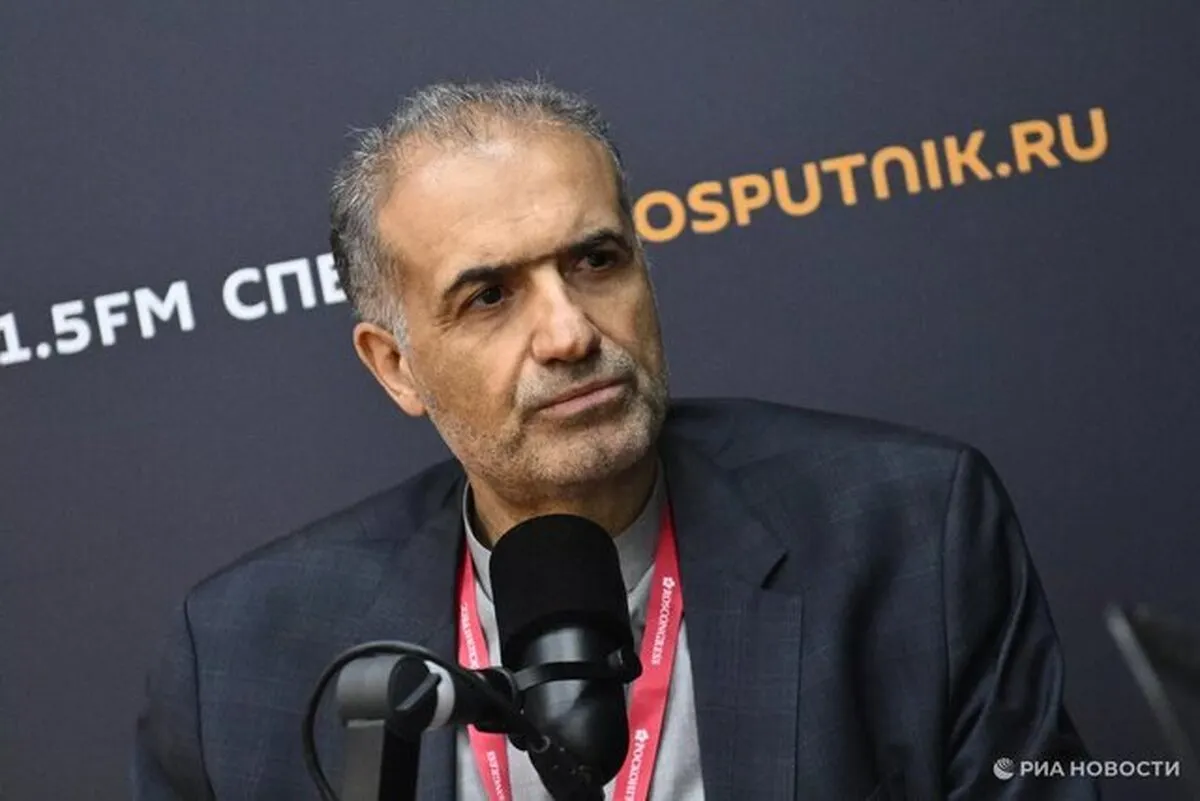
Tehran - BORNA - John Miller, a documentary filmmaker for Press TV, spoke with Kazem Jalali, the Ambassador of the Islamic Republic of Iran to Russia.
In this interview, Jalali announced that the 2001 Iran-Russia treaty, following its renewal, was updated with new amendments in 2025, and as the mother document for relations between the two countries, it covers bilateral, security, and defense cooperation.
The Iranian Ambassador to Russia said that the Islamic Republic of Iran was able to shine with its military capability in the recent conflict, and Russia also played an effective political and diplomatic role by issuing three statements and providing support in the Security Council.
Jalali emphasized that Iran had no request for the S-400 prior to the Israeli aggression, and other military collaborations are proceeding according to plan and with adherence to confidentiality.
He explained that the nature of Iran's agreement with Russia is different from Russia's pacts with Belarus or North Korea, and Russia's proposals for joint defense pacts are still in the preliminary stages.
The Ambassador said that the West's misbehavior since the Islamic Revolution and the recent sanctions against Russia have brought the two countries closer, and both are opposed to unilateralism and seek multilateralism.
Jalali emphasized that Iran has always been ready for negotiation and has adhered to cooperation frameworks with the Agency but will not accept negotiations that lead to imposition or surrender.
He stated that global crises have a single root, and the excessive demands of international powers have entrapped oppressed nations.
Jalali announced that Iran considers the Syrian nation a friend and brother, and relations with that country are subject to high-level system decisions that proceed with close consultation with Russia.
The Ambassador said that despite the historical record, modern Iran and modern Russia are shaping new frameworks for relations, and they must build trust through public diplomacy and expanding people-to-people and private sector ties.
The full text of the interview, as published by the Iranian Embassy in Russia, is as follows (Q&A format):
Is Iran satisfied with the recent strategic cooperation agreement? What is most important to you? Is anything missing?
As you know, we had a treaty with the Russian Federation around 2001, which was twenty years, and after its completion, it was renewed for five years until 2026. Fortunately, in recent years, the country's officials tried to update the treaty, which practically came to fruition in 2025.
Naturally, the treaty opens a new chapter in relations, meaning they move forward based on better amendments. We prepared the draft of the treaty in Iran and tried to propose what is needed for the relations between the two countries. Our friends in Russia also spent a lot of time strengthening this treaty, and we think we have a very good treaty as a mother document that we can rely on, and we see the horizon of relations as completely clear. We included what was necessary for relations between the two countries; in the fields of bilateral, security, military, and defense cooperation, and so on, in this treaty.
Were you satisfied with the amount of help Russia provided during Iran's recent confrontation with Israel? Some criticisms were raised that more actions could have been taken by Russia. Did you expect more help?
The relationship between our two countries is a strategic one. The text of the agreement states that if our countries are attacked by a third party, neither of us can help the third party. This cooperation and aid can be divided into two sections: one is the military sphere. I think we have had very good progress in the military sphere, especially after the eight-year war with Saddam. As everyone witnessed, the Islamic Republic of Iran was able to shine very well in this 12-day war. Our missiles performed very well, despite the enemy trying to use the element of surprise; in fact, they abused it.
On the Friday that the enemy attacked us, we were supposed to have indirect negotiations with the American side in Muscat on Sunday. On the other hand, the enemy's other deceptive plan was to assassinate and martyr our military commanders. Despite this, our military forces, with the prudence of the Commander-in-Chief, were able to recover very quickly.
Therefore, we practically used what we had in the military sphere and utilized them. But in the political and diplomatic spheres, Russia played a very good role.
On the very first day of the Zionist regime's aggression, our country's officials had a phone conversation with Mr. Putin and others, and on the second day, Dr. Araghchi had a phone conversation with Mr. Lavrov.
The Russian government issued three statements during these 12 days. The statements of the Russian Ministry of Foreign Affairs were very strong in condemning the Zionist regime and its aggression, and also defending the positions of the Islamic Republic of Iran, and they defended us in the meeting held at the United Nations Security Council.
Are you dissatisfied that the S-400 air defense system and Su-35 jets have not been delivered? Was there an agreement? Why haven't they been delivered?
I have also said in other media that we had no request for the S-400 from the Russian Federation before the Israeli aggression against Iran. But regarding the rest of the military collaborations and contracts, they are all proceeding according to their schedule and by agreement, and naturally, some of the collaborations we have are time-consuming.
Of course, many of our enemies also delve into the military-defense relations between the two countries so they can understand the secrets. Since the principle of confidentiality is the basis in military cooperation, what I, as the Ambassador of the Islamic Republic of Iran, can say is that it is proceeding according to plan.
This agreement lacks a mutual defense clause. Was Iran seeking a stronger defense alliance? Has Russia ever offered closer defense partnership?
As you mentioned, military and defense cooperation is included in the agreement between Iran and Russia. In the area of our countries being subjected to aggression, it states that we should not provide aid to a third party. The type of treaty the Islamic Republic of Iran has with the Russian Federation is different from the treaty the Russian Federation has with Belarus or North Korea. But regarding whether there have been proposals from Russia, yes, sometimes Russian friends are interested in increasing the members of the Collective Security Treaty Organization, or when Mr. Lavrov spoke with ambassadors about the possibility of creating another type of defense pact among like-minded and convergent countries against NATO, but these are still in preliminary negotiations and have not been finalized yet. These proposals were not specific to the Islamic Republic of Iran either, but were directed at countries aligned with Russia.
After the 1979 Revolution, our entire effort has been to stand on our own feet. We have built our security system and doctrine on our national capability.
Has the West's behavior, sanctions, and war brought Iran and Russia closer together?
Yes, naturally, the West's behavior has brought us closer together, and there is no doubt about that. But the point is that the Islamic Republic of Iran and the Russian Federation are two important regional countries and are among the influential countries, and are neighbors at the same time. Regardless of the views of others, we must maintain our relations in a stable manner. The outlook for our relations is completely bright.
So, the first point is that as two neighboring countries, we must definitely advance and regulate our relations well with each other. But the point you mentioned, yes, as a secondary factor, the West's behavior has actually brought the two countries, Iran and Russia, closer together.
Russia was a country that was more interested in being close to the West, and after the collapse of the Soviet Union, Russia tried to rebuild its relations with the West... This effort to rebuild relations with the West continued during Mr. Yeltsin's era. In the new era, Mr. Putin also made his efforts, stating both in announced positions and in various interviews that they wanted to become members of NATO and the European Union, but the Westerners did not accept Russia. So, the West's behavior towards Russia was inappropriate, and they practically did not accept Russia, which is why the Russians interpret that the Westerners are seeking the disintegration of Russia.
On the other hand, the Islamic Republic of Iran also faced challenges with the West after the 1979 Revolution due to the mistreatment the West showed before the Revolution. The West, instead of correcting its behavior towards the Islamic Republic of Iran after the Revolution, continued its misbehavior, such as the war in which they incited Saddam against us, and then the sanctions and threats they carried out. You know that they shot down our passenger plane with the USS Vincennes aircraft carrier in the sky, martyring about 300 of our people, and there is a detailed list of these crimes.
So, we and Russia are common in being harmed by the West; each of us has been harmed in a way. In the case of Russia, you also saw that sanctions were imposed against this country, and in fact, what happened against Iran also happened against Russia, and naturally, this also increased our convergence and brought our views closer in the field of global management. We both became opposed to unilateralism and sought multilateralism.
Can Russia help you in negotiating a nuclear deal with the West?
The position of the Islamic Republic of Iran on various issues is completely transparent and clear. The first point is that the frameworks of the country have been determined by our Leader, President, Foreign Minister, and other senior officials, such as the Secretary of the National Security Council.
The second point is that we have never left the negotiating table. Especially in these twenty-two or three years that Iran's nuclear issue has been ongoing, we have always welcomed dialogue, and precisely because we do not want to pursue the non-peaceful use of nuclear energy, we have made every effort to fully comply with the regulations related to the International Atomic Energy Agency.
So, on the one hand, our cooperation frameworks are completely clear, and on the other hand, it is clear that we will not pursue an atomic bomb. In this path, we have always welcomed the influence of our friendly countries. The Islamic Republic of Iran has never shied away from the influence of friendly countries, but based on the specific frameworks we have, which have been announced before, and we are not seeking excessive demands, the atomic bomb, or violating international laws. Today, it is completely clear who has violated international rules. The Zionist regime has several hundred nuclear warheads in the region, is not a member of the NPT, and has ignored all international rules. Not only international rules, but the basics of human laws have been violated: such as torture, starvation, and killing of civilians and genocide...
In addition, the Americans have also shown that they support the Zionist regime and have completely ignored international regulations and laws. In the words of one of the great world leaders, international rules are a scandalous matter in their view, meaning they do not tolerate international laws.
Iran has always been, and is, ready for negotiation, but as our Supreme Leader and other officials have stated, we do not accept negotiations that lead to imposition or surrender. We naturally do not accept negotiations where the results are dictated to us beforehand, and we are merely asked to sign.
Are the Ukraine war and the war against Israel part of the same Western effort to maintain global dominance? And has closer cooperation between Iran, Russia, and China become more important?
The root of crises in today's world is a single root. In the West Asia or Middle East region, the Zionist regime acts with excessive demands and is not seeking to establish peace and security, and on the other hand, this restless and uneasy regime, during the 80 years since it was established illegally, has tried to constantly create unrest and seek excessive demands in the region.
The situation in Ukraine is similar. No one is happy with war, and we believe that wars should end as soon as possible. But we must also look at the perpetrators of the war. The two nations of Ukraine and Russia have a single root, they have one nation, Kyiv was the capital of Russia for years, and Ukraine was next to Russia for years. What factors drive two nations that have been neighbors and will continue to be neighbors to the stage of conflict? This is a topic that I believe is worth contemplating. Practically, the excessive demands of international powers create such a situation for the oppressed nations of the world.
Russia recently asked Iran to have better relations with Syria. Is that possible?
A: We always consider the Syrian nation to be our friend and brother, just as we view other nations. Like the nations of Lebanon, Yemen, Saudi Arabia, the UAE—all these nations within the region are our friends, and especially our co-religionists, and we are all Muslims. We are naturally saddened and concerned by the suffering of any of these nations, and this concern naturally exists for the Syrian nation as well. The Islamic Republic of Iran has never cut off its relations with any nation. Naturally, these are subject to the high decisions of our country, and thank God, with the wisdom of our officials, accurate decisions will be made at the highest levels, and naturally, because our relationship with Russia is close, we constantly consult and dialogue.
Given the historical background of mistrust between Iran and Russia, what is the current situation, and what measures are you considering for building trust?
As was evident in your question, like all other nations, we have a historical background. This history between us and Russia is very long, and naturally, we have bitter and sweet memories in this long history. Naturally, these memories also exist in the minds of our people. These memories are somewhat deeper in our people because we suffered some defeats, which I do not intend to elaborate on. What is important is that we must manage and build the present well and carefully using past experiences.
Naturally, one cannot live in the past... My point is that all countries try to have past experiences but manage the present space for their relations. We are doing the same with Russia. We think that new Iran and modern Russia are shaping the frameworks of their relations.
We believe that this Russia is not the Tsarist Russia, and today it is completely different, and our approaches to each other in the international and regional arenas have become very close. What should be done? There are many things. For example, one part is that we should not be indifferent to the public opinion of the two countries. Both countries, especially in the field of public diplomacy, should try and perform better. Sometimes rumors and issues are raised inside Iran. We ourselves try to manage this to respond to these rumors, but I think it would be better if Russia carries out its public diplomacy more accurately and has a program for convincing Iranian public opinion. If we want to manage the relationship in a modern way, we need a kind of convincing behavior.
End Article