Can Trump bring Beijing on board with economic war against Iran?
Tehran - BORNA - China, the largest buyer of Iranian oil, has come under renewed scrutiny following US Treasury Secretary Scott Bessent’s threats under what Washington calls “Operation Economic Exclusion,” targeting countries that continue doing business with Iran.
Beijing has explicitly rejected unilateral US sanctions and reaffirmed what it says is its right to conduct normal trade with Iran and Russia.
Chinese Foreign Ministry spokesperson Lin Jian has warned that Beijing will take “all necessary measures” to safeguard its interests, describing economic coercion as an escalation of tensions and a threat to the global financial order.
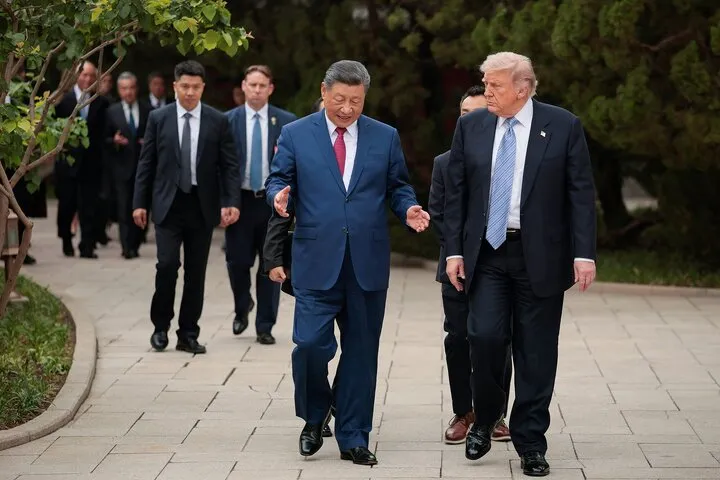
The stance comes ahead of an expected visit by Chinese President Xi Jinping to the United States and amid negotiations over extending a trade truce between the world’s two largest economies, further complicating Washington’s calculations.
CNN wrote in an analysis that Washington has limited options for forcing Beijing to comply.
Zhao Long, director of the Institute for Global Governance Studies at the Shanghai Institutes for International Studies, said China was unlikely to accept a framework under which the United States determines what trade with third countries is considered lawful.
Accepting such a condition, he said, would establish a dangerous precedent for the use of secondary sanctions against Chinese commercial interests.
Washington, however, has so far adopted what CNN described as a strategy of “quiet diplomacy,” seeking to apply pressure behind the scenes rather than publicly singling out China.
What options does Washington have to pressure China despite Beijing’s economic leverage?
CNN said China imports Iranian oil through an opaque system designed to remain largely insulated from the US dollar-based financial system and sanctions.
Small independent Chinese refineries, commonly known as “teapots,” purchase and process sanctioned Iranian crude through a network of ports, financial institutions and tankers that are often similarly shielded from international scrutiny.
China has for years stopped officially recording many of those purchases, particularly since sanctions on Iran were reimposed after the first Trump administration withdrew from the 2015 nuclear agreement.
Analysts, however, say Washington still has potential pressure points.
Max Meizlish, a senior research analyst at the pro-Israel Foundation for Defense of Democracies in Washington, said many entities involved in the trade are ultimately linked, directly or indirectly, to major Chinese state-owned companies that remain deeply integrated into the US dollar system.
“When you look at the upstream ownership structure of these entities, you find that many of them are directly or indirectly owned by large Chinese state-owned enterprises that are heavily integrated into the US dollar system,” he said.
“By sanctioning their subsidiaries, the United States can put pressure on parent companies to divest from those investments, or otherwise risk being deemed to be providing direct or indirect support to sanctioned entities.”
Despite Bessent’s warning that no one would be beyond the reach of US sanctions, Beijing has previously seen Washington threaten sweeping measures only to later pull back.
China is also aware that Washington recognizes Beijing’s substantial economic leverage, particularly its dominance over the global supply of rare earth elements that are critical to strategically important industries.
Sun Chenghao, a senior fellow at the Center for International Security and Strategy at Tsinghua University in Beijing, warned that sanctioning major Chinese banks would provoke a strong response from Beijing.
“If Washington crosses that threshold, Beijing will certainly respond, and the political atmosphere for a leaders’ meeting between Trump and Xi would deteriorate sharply,” Sun said.
Such a move might not automatically cancel the meeting, he added, but could shift it “from stabilization toward damage control.”
Zhao also referred to Beijing’s repeated calls during the third war against Iran for freedom of navigation through the Strait of Hormuz and for all parties to avoid further escalation in the region, given China’s dependence on energy imports passing through the strategic waterway.
“Any cooperation with the United States aimed at restoring regional peace should not be reduced to doing Trump a favor,” Zhao said.
“Beijing is willing to help bring the crisis to an end, but it is not willing to become an instrument of Washington’s maximum-pressure strategy.”
End Article