US judge rules Trump administration violated rights of pro-Palestinian international students
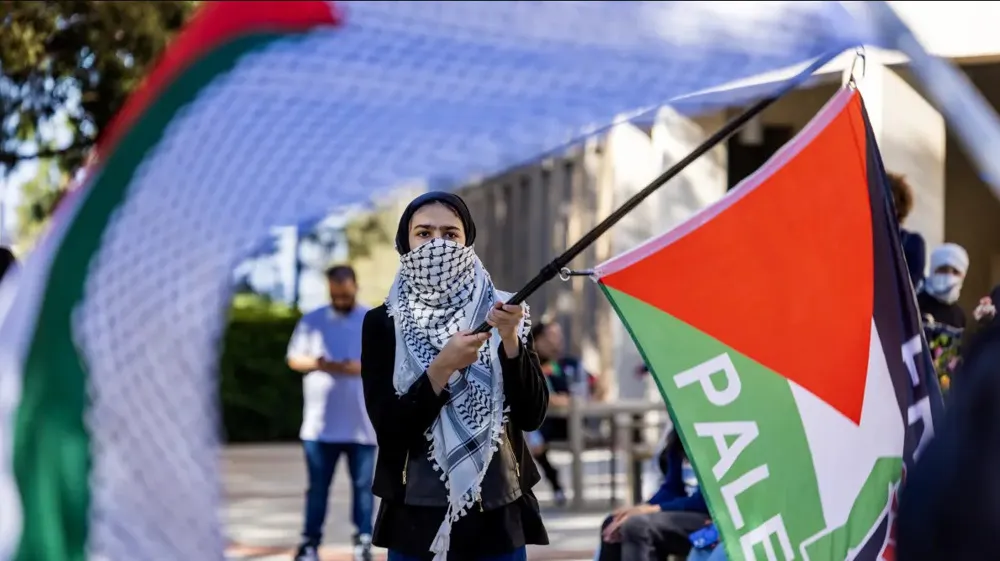
Tehran - BORNA - US District Judge Noel Wise issued the 90-page ruling in California on Friday, criticizing the Department of State and Department of Homeland Security (DHS) for attempting to use immigration measures against non-citizens over speech protected by the First Amendment.
“Stated plainly, in the United States, freedom of speech belongs to the people,” Wise said in her decision. “It is not the government’s to take.”
Wise, who was appointed by former President Joe Biden, said that the ability to criticize the government and its top officials was an indication of the strength of democracy.
“That strength is diminished when members of our society — citizens and non-citizens alike — must self-censor and ‘behave’ or suffer the government’s retaliation,” she said.
The ruling focused on actions taken by the second Trump administration to revoke the visas and detain international students in the US after they participated in pro-Palestinian advocacy.
The campaign drew widespread attention after the detention of Columbia University graduate student Mahmoud Khalil in March 2025.
Khalil, a graduate student and permanent US resident, had become a prominent figure in the student protest movement at Columbia University and served as a key negotiator for student groups.
He is separately challenging his deportation.
On Saturday, Khalil welcomed Wise’s ruling in a post on X. “No one should fear speaking up for Palestine,” Khalil wrote.
Actions such as Khalil’s arrest became part of the basis for a lawsuit against US Secretary of State Marco Rubio, who was named as one of the defendants.
In August 2025, The Stanford Daily, an independent student newspaper at Stanford University, filed a complaint, arguing that some of its non-citizen writers had stopped covering pro-Palestinian protests because of the administration’s actions.
Two anonymous plaintiffs also joined the case. They identified themselves as foreign nationals with no criminal records and said they had felt compelled to self-censor because they feared losing their student visas.
The lawsuit was filed by the Foundation for Individual Rights and Free Expression (FIRE).
The Trump administration has tried to defend its deportation efforts by citing “provisions of the Immigration and Nationality Act.”
One provision gives the secretary of state authority to “exclude” foreign nationals if their presence could result in “potentially serious adverse foreign policy consequences for the United States.”
Critics of the administration’s approach have argued that the “provision” has received limited judicial testing and does not override the First Amendment’s protection of free speech.
Wise, in her ruling, criticized Rubio’s implementation of the visa revocation policy, describing its enforcement as “standardless.”
“The record does reveal one clear pattern in the enforcement actions the government has taken to revoke non-citizens’ visas since March of 2025,” the judge wrote.
“The secretary revokes visas when non-citizens are critical of the government or the causes or people it favors. This exemplifies ‘seriously discriminatory enforcement.’”
Conor Fitzpatrick, a lawyer with FIRE, described the decision as a victory for First Amendment protections.
“Today’s ruling proves that free speech isn’t a privilege, but the inalienable right of every man, woman, and child,” Fitzpatrick said in a statement.
The Trump administration has encountered other judicial challenges to its efforts involving non-citizen students and academics who engaged in pro-Palestinian advocacy.
In September 2025, a federal judge in Massachusetts ruled that US officials had violated the First Amendment when they attempted to detain and deport non-citizen students and academics over such advocacy.
That case was brought by a coalition of education groups, which argued that the administration’s deportation policy had created “a climate of repression and fear on university campuses.”
End Article