Baghaei: Ceasefire Guarantors, Especially the U.S., Responsible for Israel’s Ongoing Crimes in Gaza
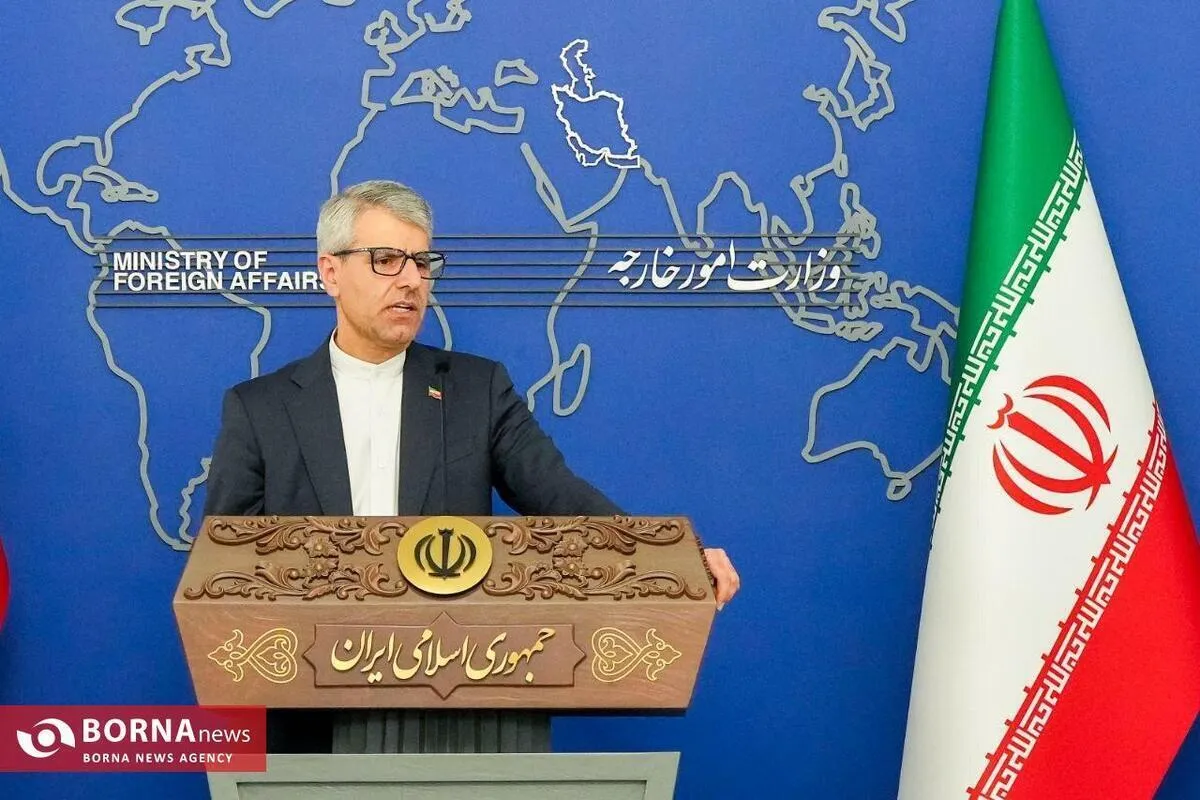
Tehran - BORNA - Esmail Baghaei, at the beginning of his press conference on Monday, referred to several recent regional and international developments and said: “The most important issue in our region still relates to Palestine.”
He added: “Despite the understanding that was apparently reached last week in Sharm el-Sheikh, we are still witnessing the continuation of massacres by the Israeli regime in Gaza and the West Bank, and so far the ceasefire has been violated dozens of times by the Israeli regime.”
Baghaei continued: “The Rafah crossing also remains closed. The guarantors of the ceasefire in Gaza, particularly the United States, through their inaction, have caused the continuation of the Israeli regime’s crimes in this region.”
We Hope the Ceasefire Between Afghanistan and Pakistan Will Lead to Understanding and Prevent Future Clashes
The senior Iranian diplomat, referring to the recent clashes between Pakistan and Afghanistan, said: “These clashes were worrying for us. We called on both sides to exercise restraint and emphasized that stability in the region is important.”
Baghaei noted: “We are pleased that both sides announced a ceasefire yesterday, and we hope this process will lead to an understanding-based path and prevent the recurrence of such conflicts.”
He also presented a report on last week’s meeting of the foreign ministers of the Non-Aligned Movement in Uganda, saying: “In this meeting, member states (120 countries) opposed the illegal action of three European countries against Iran at the UN Security Council and supported Iran’s positions and rights.”
The Action of the Three European Countries Regarding the Snapback Has Created Legal Confusion in the Security Council
The Foreign Ministry spokesperson also said in another part of his remarks: “We must consider UN Security Council Resolution 2231 terminated as of October 18, and the UN Secretariat should act accordingly.”
He added: “Of course, we know that the action of the three European countries has created legal confusion in the Security Council, but this is not our responsibility — it lies with those three European countries.”
He emphasized: “The majority of the international community opposes the approach of the United States and some European countries regarding their misuse of international mechanisms.”
Iran–Russia Cooperation Continues Within Previous Frameworks
The Foreign Ministry spokesperson, responding to a question about the recent statement of the Russian foreign minister that Moscow has no restrictions on military and technical cooperation with Iran and is ready to cooperate with Tehran in this regard and in providing defense systems, said:
“The process of cooperation between Iran and Russia is growing in all areas. We have several fundamental agreements with Russia that cover a wide range of topics, including defense cooperation.”
He added: “Given that, in our view, Russia’s view, and the view of the majority of the international community, Resolution 2231 has expired, cooperation between Iran and Russia will continue within previous frameworks.”
There Is Willingness on Both Sides to Resolve the Prisoner Exchange Issue Between Iran and France
The spokesperson also, in response to a question about the latest situation regarding the prisoner exchange process between Iran and France and the release of Ms. Mahdi Esfandiari, the Iranian citizen detained in France, said:
“We are seriously following up on this issue, and I believe both sides have the necessary will to resolve it.”
Russia’s Special Envoy on Syria Is in Tehran
Baghaei, in response to another question regarding the recent visit of Ali Larijani, Secretary of the Supreme National Security Council, to Russia and his meeting with President Putin, and reports suggesting that Putin might mediate between Iran and the United States, said:
“We constantly consult with our friends in the region on various issues related to security and national interests, and contacts with Russia continue at different levels in this framework.”
He added: “Within this framework, today the Russian special envoy for Syria is in Tehran and is scheduled to meet and hold consultations with officials from Iran’s Ministry of Foreign Affairs.”
Baghaei continued: “These contacts take place as part of the cooperation and consultations between the two countries in various fields.”
There Has Never Been a Case Where the Israeli Regime Made a Promise and Fulfilled It
Continuing his weekly press conference, Baghaei, emphasizing the clear position of the Islamic Republic of Iran regarding Gaza, said: “Since the beginning of the genocide in Gaza, we have emphasized the need to compel the Israeli regime to stop the massacres, break the inhumane blockade, allow the delivery of humanitarian aid without obstruction, withdraw its occupying forces, and begin the reconstruction of Gaza.”
He added: “These demands are humanitarian and undeniable, and no responsible country or human being can reject them.”
Baghaei continued: “Every day that reduces the suffering of the Palestinian people is a source of relief. But the concerns we have expressed from the beginning are based on past experience. There has never been a case where the Israeli regime made a promise and fulfilled it. In Lebanon, over 5,000 ceasefire violations have been recorded, and in Gaza, only in recent days, more than 80 violations have occurred. In one of these cases, 11 members of a family were martyred, and the crossings have not been reopened.”
The Foreign Ministry spokesperson, criticizing the performance of the ceasefire guarantors, said: “The concerns we had are now clearly visible. The Israeli regime is not serious in its claims, and unfortunately, the guarantors have not fulfilled their obligations as they should have.”
Participation in the Sharm el-Sheikh Meeting Was Not in the Country’s Interest
In another part of his remarks, Baghaei referred to the Sharm el-Sheikh meeting and said: “Decisions about participation in a process or diplomatic event of this level of importance require detailed expert review by the Ministry of Foreign Affairs and other relevant institutions. The expert opinions were prepared and reviewed by higher bodies, and finally, the conclusion was that participation in such an event was not in the interest of the country and its national interests.”
The IAEA Must Maintain Its Integrity and Independence
The senior Iranian diplomat also commented on the remarks made yesterday by Rafael Grossi, Director General of the International Atomic Energy Agency (IAEA), about Iran’s nuclear activities, saying:
“We have always emphasized that the Agency must act within its mandate and away from the political motives of certain member states.”
He added: “We have consistently emphasized that the Agency must maintain its character and independence and should not allow itself to be used for the political agendas and ambitions of the United States and some European countries.”
We Welcome the Signing of the Ceasefire Agreement Between Afghanistan and Pakistan
The spokesperson of the Ministry of Foreign Affairs, in response to a question about the assessments made regarding the establishment of a ceasefire between Pakistan and Afghanistan and the origins of these clashes, said: “There are various analyses about why the conflict between Pakistan and Afghanistan started and continued.”
He added: “What is important for us is to see tensions between these two countries stop and peace established between them, because whatever happens in these two countries has consequences for the entire region. As I mentioned, we welcome the signing of the ceasefire agreement between the two countries.”
The Legal and Environmental Departments of the Foreign Ministry Are Consulting with Iraqi Officials Regarding Hoor al-Azim Wetland
The spokesperson of the Ministry of Foreign Affairs, referring to the issue of the Hoor al-Azim wetland and the follow-ups made by the Ministry of Foreign Affairs in this regard, said: “Our legal department, as well as the environmental section, are in contact and consultation with Iraqi officials on this matter.”
We Have a Valuable Relationship with India
In response to a question regarding Iran–India interactions and India’s role as one of the major members of the Non-Aligned Movement, he said: “India is an important country, and we have a valuable relationship with this country.”
Addressing the journalist, he said: “We are determined to continue this relationship, and as you mentioned, India is one of the important members of the Non-Aligned Movement.”
We Cannot Claim That We Are on the Verge of a Negotiation Process
The Foreign Ministry spokesperson, in response to a question that Mr. Witkoff, in a recent interview, said that they have received contacts from Iran, said: “Indirect contacts between Iran and the other parties have more or less continued in recent days as before, and intermediaries have exchanged messages between us and them.”
Baghaei added: “However, we cannot claim that we are on the verge of a negotiation process.”
We Have Not Yet Reached a Conclusion Regarding Participation in the Gaza Reconstruction Conference
The senior Iranian diplomat, in response to a question about whether Iran intends to participate in the Gaza reconstruction conference to be held in Egypt and, more generally, about Iran’s plan to help the people of Gaza, said: “We have not yet reached a conclusion regarding this event and need to finalize our position.”
He continued: “Regarding the principle of assistance to the Palestinians and the people of Gaza, as we emphasized in our October 5 statement, in addition to stressing the need to stop the genocide in Gaza, we will not refrain from providing any possible assistance to the people of Gaza.”
As Long as Excessive Expectations Exist, There Will Be No Basis for Negotiation or Understanding
The spokesperson of the Ministry of Foreign Affairs, regarding talks with the United States and whether Egypt is the new mediator of the Iran–U.S. negotiations, said: “Indirect contacts between us and the other parties have continued more or less, but this does not mean entering a negotiation phase.”
He added: “Negotiations take shape when the parties reach the conclusion that they must respect each other’s positions and rights and address one another’s concerns on an equal footing. We are not at that stage, and as long as excessive expectations and demands exist, there will be no grounds for negotiation or understanding.”
Baghaei, referring to the efforts of some countries to mediate during the past year, added: “Naturally, countries that have made efforts to help resolve issues will continue their efforts.”
He also referred to Iran’s ongoing consultations with Egypt, saying: “In our talks with the Egyptian foreign minister, one of the main topics is the situation in Gaza. Egypt, as one of the guarantors of the ceasefire understanding, plays an important role, and in every contact, we emphasize the need to stop the massacres and crimes of the Zionist regime in Gaza.”
Provincial Diplomacy Conference Is a Joint National Initiative
In response to a question about the second Provincial Diplomacy Conference of the Ministry of Foreign Affairs held in Mashhad, the spokesperson said: “This is the second conference in the framework of provincial diplomacy, and the subject is not limited to the Foreign Ministry. There is a clear consensus across various parts of the government, including the economic and trade ministries and the Foreign Ministry, about the usefulness of this initiative.”
Baghaei added: “In this conference, the governors of Khorasan Razavi, North, and South provinces, Iran’s ambassadors to neighboring countries including China and Russia, and trade and business representatives focusing on eastern and northeastern countries participated. We hope that by continuing such meetings in other provinces, both executive and administrative bodies of the country will become more familiar with provincial capacities, and direct contact and communication between local economic actors and corresponding foreign counterparts will be facilitated. This process can help streamline economic and trade activities with neighboring countries.”
General Topics of Larijani’s Trip to Russia Are Known
The Foreign Ministry spokesperson, in response to an question about whether during the recent visit of Ali Larijani, Secretary of the Supreme National Security Council, to Russia—and given the simultaneous visit of Al-Jolani to Moscow and his meeting with President Putin—any discussion regarding Iran–Syria relations took place, said:
“As you mentioned, Mr. Larijani’s trip to Russia took place, but regarding the issue you raised, I have no information and need to ask about what was discussed in that visit, although the general topics of the talks are known.”
He added: “As for the visit of the Russian special envoy for Syria to Tehran, since it took place today, we will speak about it and its results in next week’s press briefing.”
The Weapons of Resistance Are a Matter to Be Decided by the Palestinians Themselves
In response to another question that the U.S. special envoy for West Asia said if the Lebanese government does not disarm Hezbollah, the Zionist regime will take unilateral action, Baghaei said: “We have always expressed our concern about the Israeli regime’s habit of not fulfilling its commitments, and the fact that this regime does not act on its obligations is nothing new.”
The Foreign Ministry spokesperson added: “As the resistance movement Hamas has stated, the issue of resistance weapons is one that must be decided by the Palestinians themselves.”
Baghaei said: “When the United States and the Zionist regime make such statements, it is in fact a kind of preparation for repeating their previous breaches of commitment, and the international community must exercise due vigilance in this regard.”
Support of the Yemeni People for Palestine Is an Expression of Human Commitment
In another part of his over one-hour press conference, the spokesperson, in response to a question while expressing condolences and congratulations on the martyrdom of Yemen’s Chief of Staff, said: “He was martyred in the path of fighting against occupation and the genocide of the Zionist regime.”
He added: “The people of Yemen have shown over the past two years how serious they are in supporting the Palestinian cause, which is a legal responsibility of all countries. What the Yemeni people have done is an expression of human commitment, and this must be honored by everyone.”
Measures Taken to Regulate Foreign Nationals in Iran
The senior Iranian diplomat, in response to a question that, according to some reports, Mr. Bahrami, Director General for South Asia at the Ministry of Foreign Affairs, said in a meeting with an Afghan embassy official in Tehran that work visas will be issued for Afghan citizens, stated:
“In general, we have taken measures to organize foreign nationals in the country.”
He added: “In this context, we have adjusted the type and process of visa issuance for Afghan applicants. This is one of the matters on our agenda, and what the Director General mentioned refers to this issue.”
The United States Must Be Held Accountable for Gross Human Rights Violations
The Foreign Ministry spokesperson, responding to a question from Press TV about the case of an African-American woman injured due to police brutality, said: “We do not intend to imitate the U.S. habit of interfering in other countries’ affairs, but we have always emphasized the need to respect the rights of all segments of American society, especially Black people, people of color, and those of African descent.”
He stressed: “Regardless of political discussions and disputes we have with the United States, the issue of institutionalized racial discrimination within different levels of U.S. governance, especially in law enforcement and the police, is a real matter. Sometimes an incident reminds both American society and the international community of this reality, and unfortunately, in the past year, this issue has intensified due to some official U.S. government policies.”
Baghaei noted: “We have the case of George Floyd, a Black individual who was abused and killed by the police, and the subsequent events that followed. In this case as well, the scene was truly shocking and heartbreaking—a police officer violently confronting a Black woman in front of her children. These are clear examples of gross human rights violations, and naturally, the United States, as a member of many international human rights instruments, must be held accountable and take measures to prevent such incidents from happening again.”
The Majority of the International Community Opposes Unilateral Approaches
In response to a question about reports that some European countries not part of the European Union intend to implement the snapback mechanism, the Foreign Ministry spokesperson said: “Many countries in the international arena have stated that they do not intend to implement it and oppose the action of the three European countries.”
He added: “Some of these European countries that have announced this are candidates for EU membership, and they have made this announcement in that context. Every UN member state has its own obligations and limitations, and we have emphasized that this action is contrary to their international commitments. The majority of the international community opposes unilateral approaches.”
The Three European Countries, Following U.S. Demands, Insisted on Restoring Rescinded Sanctions Resolutions
In continuation of the press conference, the spokesperson of the Ministry of Foreign Affairs of the Islamic Republic of Iran, in response to a question, stated: Given the likelihood of misuse of the JCPOA dispute resolution mechanism by the three European countries, over the past year we have tried to bring the other parties to the conclusion that resorting to the so-called “snapback” mechanism not only does not help improve diplomatic processes, but will make the issue more complicated.
Referring to the New York talks and the Cairo understanding with the International Atomic Energy Agency, he added: Unfortunately, the other parties, by following the demands of the United States, insisted on restoring the rescinded sanctions resolutions—meaning those resolutions adopted at the Security Council between 2006 and 2010 under the pretext of Iran’s nuclear program.
The Foreign Ministry spokesperson continued: In practice, two permanent members of the Security Council opposed this move. Since Germany is not a member of the Security Council, this opposition means the Security Council failed to adopt a decision on restoring the sanctions resolutions. And this is an exact legal proposition.
Baghaei also referred to the broad international support for Iran’s position and said: The majority of the international community, including the 120 member states of the Non-Aligned Movement, supported Iran’s stance. China and Russia played a very important role in this process. Russia, from the outset, explicitly announced its position and emphasized that the move by the three European countries has no validity either legally or procedurally. Essentially, these countries lack the standing to resort to this mechanism, since they themselves are violators of the JCPOA.
The Recent Remarks of the German Chancellor Are an Explicit Admission of the Lack of Will Among the Three Countries to Play a Positive Role in Regional Developments
In today’s press conference, in response to a question regarding Iran’s relations with the European troika, Baghaei criticized the performance of the three European countries in international developments, especially in the Middle East region, and emphasized: The three European countries must demonstrate that they truly possess the will and the necessary capacity to act as a reliable and credible negotiating party. But we have not observed such a thing to date.
Referring to the available evidence, he added: There are even indications that the European side itself admits to its inability or lack of will to play a positive and constructive role. The recent interview of the German Chancellor contains points to the effect that the European Union, even if it had wanted to, could not have played a role in developments related to the Middle East. This is an admission that the European Union—and in particular the aforementioned three countries—are incapable of playing a positive and effective role in international developments, especially in our region.
The Foreign Ministry spokesperson also referred to another part of this interview and said: In this conversation, the German Chancellor cited the lack of military tools as the reason for the European Union’s inability to influence regional developments. This statement is both worrying and an explicit admission of the lack of will or capacity among these three countries to play a positive role in regional developments.
Concluding his answer to this question, Baghaei, referring to the recent efforts by the three European countries to restore rescinded resolutions against Iran, said: Unfortunately, in this process too we witnessed a similar approach, indicating their lack of will and absence of initiative.
The Presence of U.S. Troops in Afghanistan Brought Nothing But Insecurity, Terrorism, and an Increase in the Production and Trafficking of Narcotics
In today’s press conference, responding to the recent remarks by the U.S. President about the intention to return U.S. forces to Bagram Air Base in Afghanistan, the spokesperson of the Ministry of Foreign Affairs of the Islamic Republic of Iran referred to the experience of the 20-year presence of the United States and the NATO coalition in Afghanistan and said: This presence brought nothing to the people of Afghanistan and the region but insecurity, terrorism, and an increase in the production and trafficking of narcotics.
He added: The presence of a third, extra-regional country in one of our neighboring states is not something to which the Islamic Republic of Iran can remain indifferent. We have repeatedly emphasized that regional security must be ensured by the countries of the region.
The Foreign Ministry spokesperson also referred to the common positions of the regional countries on this issue and said: During the quadrilateral meeting in New York on the Afghanistan issue, as well as the subsequent meeting in Moscow, this matter was prominently raised, and regional countries emphasized the necessity of respecting Afghanistan’s territorial integrity.
Continuing his remarks in response to this question, Baghaei warned that the presence of foreign forces in the surrounding region not only does not help stability, but can also reinforce insecurity and increase problems for all the countries in the region.
We Should Not Use the Ill Intentions and Malevolence of the Other Side as a Basis to Disparage Our Own Negotiating Methods
In response to another question stating that, in recent days, various narratives have been presented regarding the snapback issue—facing both domestic and foreign narratives—and whether the domestic narratives are correct or the foreign ones, the Foreign Ministry spokesperson said: If I want to answer briefly—certainly the domestic narratives.
He continued: A great deal has been said about this particular issue in recent days. Every event and decision must be evaluated in its own time and context. What became known as the snapback was a solution so that the two sides could reach a result and an understanding. In the final days of the JCPOA negotiations, due to the intensity of mistrust—both ours toward them and theirs toward us—we emphasized that our nuclear infrastructure must be preserved. We emphasized that we would in no way accept zero enrichment; whereas the UN Security Council resolutions’ request of Iran was that enrichment must reach zero and Iran’s nuclear industry be effectively shut down.
He continued: We did not accept such a thing, and at any moment it was possible for us—as we demonstrated after the U.S. withdrawal from the JCPOA and after we waited one year—that from 2019 onward, when we decided, we were able to restore the data-x-items we had suspended or limited under JCPOA commitments. The other side claimed that, to guarantee the implementation of Iran’s commitments, they too needed a mechanism—a guarantee—and that guarantee could, of course, be nothing other than the rescinded Security Council resolutions.
He stated: Various initiatives were proposed in this regard; for example, the initiative that something akin to snapback would occur every six months, and every six months a new authorization would be issued for the continuation of lifting sanctions on Iran—which was not logical at all.
He added: Ultimately, we arrived at this solution that, during implementation, if the other parties felt that Iran had not implemented its commitments, then in a process they could return the sanctions—something for which, in practice, the grounds never materialized; because Iran never violated the JCPOA, and what has now occurred is the misuse of that dispute-resolution mechanism.
He said: We should not use the ill intentions and malevolence of the other side as a basis to disparage the useful actions that were taken and our own negotiating methods. I do not consider the continuation of these debates beneficial, and in my view we should focus on the situation we are presently facing. At the Security Council level, two important countries, China and Russia, currently support Iran’s position.
He continued: We should not allow issues related to the past to exert an inappropriate effect on important relationships—although we must keep in mind that the past is the lamp that lights the future.
Iran’s Nuclear Issue Is in No Way an International Dispute
In this press conference, responding to the question that some believe that, with the destruction of Iran’s nuclear facilities, Iran’s nuclear program can no longer be an issue for negotiation, the Foreign Ministry spokesperson said: We fundamentally do not believe that our nuclear issue is an international dispute; the three European countries and the United States, from the very beginning in 2002 and 2003, insisted and compelled that it be placed on the UN’s agenda.
He emphasized: Iran’s nuclear issue is in no way an international dispute; it is a pretext that, in the first instance, the Zionist regime invented and unfortunately imposed on the United Nations, and afterward the three European countries and the United States continued it under various pretexts.
The Foreign Ministry spokesperson noted: At the same time, it is a fact that this pretext still continues; we have always said that Iran’s nuclear issue must be viewed based on Iran’s rights under the Non-Proliferation Treaty; the right of the Islamic Republic of Iran—the right of the Iranian nation—to the peaceful use of nuclear energy is not a right that someone should “recognize” for us; it is a right we possess by virtue of membership in that treaty. Regarding entering any diplomatic process, whenever the other parties truly reach the conclusion that they are prepared to engage in a reasonable dialogue that takes into account Iran’s interests and legitimate rights, I believe the path is not closed.
We Used the NAM Meeting Opportunity to Engage with African Countries
In response to a question about last week’s meeting of the foreign ministers of the Non-Aligned Movement in Uganda, the members’ support for Iran’s view regarding the end of UN Security Council Resolution 2231, and what use Iran made of this meeting to expand interactions with African countries, the senior diplomat said: The Uganda meeting was the 19th mid-term meeting of NAM foreign ministers. Uganda holds the rotating presidency of the Movement, and therefore hosted the meeting on that basis. We used this opportunity to engage with African countries due to the importance we attach to them.
He added: Last year, the Iran–Africa meeting was also held, and African countries participated at a good level in the exhibition of Iran’s export achievements, and that event had a very significant impact on enhancing our trade relations with African countries.
Baghaei stated: At the NAM level, the texts adopted in the final communiqué regarding regional issues—particularly the nuclear issue—are very important. The firm condemnation of the military aggression of the Zionist regime and the United States against Iran, as well as support for the victims of chemical weapons, were among the data-x-items included in this document. Another important issue was the Movement’s support for the view of Iran, Russia, and China regarding Iran’s nuclear issue and the emphasis that the claim by the three European countries about the return of the rescinded UN Security Council resolutions against Iran has no validity or legal basis.
He added: Countries certainly adjust their conduct based on the explicit political positions they adopt. Therefore, our expectation is that these positions will also be taken into account at the implementation stage. Because we do not at all accept that the recent events have created—or will create—any special change, and mechanisms should not be created at the UN and Security Council level to operationalize the claim of the three European countries and the United States.
Baghaei emphasized: We hope to see the results of this diplomatic campaign in practice as well.
The Foreign Ministry Should Be Commended for Its Level of Engagement and Coordination with Parliament
In response to a question regarding the recent presence of the foreign minister at the Parliament’s National Security Committee and some criticisms raised about this appearance, the Foreign Ministry spokesperson said: Dr. Araghchi, as a member of the cabinet and part of the executive branch, naturally must appear before bodies to which he is accountable and required to present reports; one of these important bodies is the Islamic Consultative Assembly (Parliament).
He added: This is a completely natural and well-known process whereby ministers explain their performance to the people’s representatives and keep Parliament informed. In fact, instead of criticism, the Ministry of Foreign Affairs should be commended for this level of engagement and coordination with Parliament, since the ministry has consistently sought to keep Parliament informed about developments in the country’s foreign policy.
Baghaei emphasized: One of the main duties of the Ministry of Foreign Affairs and the minister himself is to create consensus among the various pillars of governance to facilitate and coordinate processes related to foreign policy, and significant efforts have been made in this regard.
At a Time When We Are Witnessing a Dangerous Trend of Unilateralism Internationally, the Role of Parliaments Is More Important Than Ever
In response to another question regarding the Inter-Parliamentary Union (IPU) assembly and the role of parliamentary diplomacy in articulating Tehran’s positions, the Foreign Ministry spokesperson said: IPU assemblies have always been very influential, and Iran and the Islamic Consultative Assembly have played an effective role in them.
He added: At a time when we are witnessing a dangerous trend of unilateralism at the international level, the role of parliaments is more important than ever, and through engagement with one another they can play an effective role in upholding the principles of the UN Charter and preventing trends that are to the detriment of countries that value international peace and security.
End Article