Baghaei: Speculations on 'Interim Agreement' are Baseless
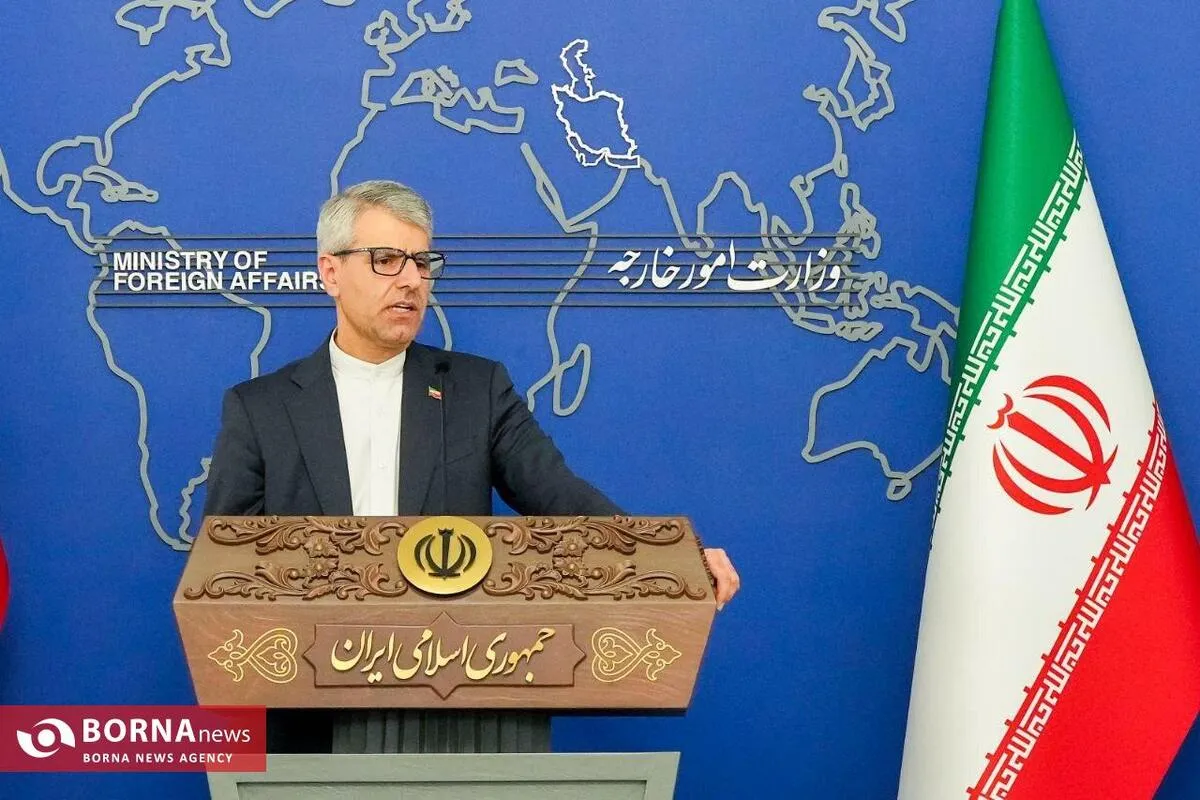
Tehran - BORNA - Esmaeil Baghaei said at his weekly press conference that while there is extensive speculation regarding the format and substance of the talks, “none of it is confirmed by us, and details circulated about the negotiations — especially regarding an interim agreement — have no basis.” He stressed that drafting any negotiating text is a joint process, adding that Iran’s position on the lifting of U.S. sanctions and nuclear-related issues is clear and that Tehran is also aware of the American side’s viewpoints.
We Are at the Stage of Drafting Positions
Baghaei noted that if good faith exists on both sides, reaching a result is possible. “We are at the stage of drafting positions,” he said, expressing hope that within the next few days another round of talks would be held, as previously announced by Foreign Minister Seyed Abbas Araghchi.
In response to remarks attributed to U.S. envoy Steve Witkoff suggesting Iran should “surrender” and claiming Tehran is only a week away from acquiring a nuclear weapon, Baghaei said contradictory statements from U.S. officials are not new. “No negotiation aimed at forcing one side will succeed — at least not in the case of Iran,” he said, emphasizing that Iran remains serious and determined in pursuing diplomacy, grounded in what it sees as the legal and logical strength of its position.
Nuclear Decisions Made Within Supreme National Security Council Framework
Addressing claims of a dual-track management of negotiations between the Foreign Ministry and the Secretariat of the Supreme National Security Council, he said nuclear-related actions are taken in accordance with decisions made by the Council. Relevant bodies, including the Atomic Energy Organization and economic institutions, participate as necessary, with final decisions adopted at the Council level and implemented by the Foreign Ministry.
On the possibility of implementing the Additional Protocol, Baghaei recalled that Iran voluntarily applied it during the implementation of the 2015 nuclear deal and that any such step would depend on reciprocal measures, particularly in the area of sanctions relief. He described it as a tool for further confidence-building regarding the peaceful nature of Iran’s nuclear program.
He stressed that sanctions relief is the core component of any agreement and must be implemented and operationalized by the United States. In return, Iran would undertake clear and transparent measures to ensure its nuclear program never moves toward militarization.
Iranians Do Not Yield to Surrender
Asked what gives Iran confidence amid a significant U.S. military buildup in the region, Baghaei said that confidence stems from “the legitimacy of our cause and Iran’s history and civilization.” He added that “the character and conduct of Iranians are not compatible with surrender,” and that for 48 years the Iranian people have sought dignity, independence, and respect for national sovereignty.
He argued that speaking of “surrender” contradicts international law, and that a nation determined to defend its independence and territorial integrity will remain steadfast.
Israel Seeks Dominance Over the Entire Region
Responding to reports suggesting Israel aims to dismantle what it calls the “Shiite axis,” Baghaei said Israeli officials have openly declared broader ambitions. “For Israel, there is no distinction between Shiite and Sunni, Arab or non-Arab,” he said, adding that Israeli officials have spoken about domination “from the Nile to the Euphrates.” Such rhetoric, he said, reinforces the perception among regional states that Israel constitutes a persistent threat to regional security.
He called for greater regional cooperation to confront what he described as dangerous developments.
Armed Forces on Alert; Threats Will Not Deter Iran
Baghaei stated that Iran’s armed forces are “fully alert and prepared to defend.” While Iran insists negotiations must be conducted free of threats, he said Tehran will not be influenced by intimidation and remains focused on advancing the rights and interests of its people. Should Iran conclude that the other side seeks to exploit negotiations for deception, it would take appropriate countermeasures.
On whether the United States would also submit a proposal, he said seriousness in negotiations requires all sides to work in good faith. Iran is preparing its positions, while any steps by the U.S. delegation should be addressed by Washington.
Regarding reports that Iran might submit a proposal package on Thursday, Baghaei said the timing and modality would be discussed with Oman as the mediator, and that Iran is currently finalizing its positions.
Inspections of Damaged Sites Subject to Protocol
On whether opening damaged nuclear sites to inspectors is a precondition in talks, he said Iran is aware of its commitments and has fulfilled its obligations regarding access to peaceful nuclear facilities. However, damaged sites constitute a different matter and, absent an agreed protocol, Iran is “not in a position” to proceed. He described inspections of such sites as an issue between Iran and the International Atomic Energy Agency, requiring an agreed framework.
EU Decision Unlawful; Reciprocal Measures Taken
Commenting on a statement by the Council of Ministers of the European Union regarding the designation of the Islamic Revolutionary Guard Corps, Baghaei said the move contravenes international law and the UN Charter, arguing that labeling part of a country’s official armed forces as terrorist is unjustified.
He said Iran’s subsequent decision to designate the naval and air forces of EU member states as terrorist entities was a reciprocal response to what it considers an unlawful act, adding that this designation will have consequences for how their presence is viewed.
“No Such Thing as a Limited Attack”
Asked about U.S. rhetoric suggesting the possibility of a “limited attack,” Baghaei said: “There is no such thing as a limited attack. An act of aggression is an act of aggression.” Any such move would be treated as aggression under international law, and Iran would respond within its inherent right to self-defense with a “firm and severe” reaction.
Baghaei described U.S. contradictory statements as a major obstacle in negotiations.
On tensions between Pakistan and Afghanistan, he urged restraint and dialogue, emphasizing Iran’s readiness to help reduce tensions.
Responding to remarks by former U.S. House Speaker Nancy Pelosi about sanctions, he said recent admissions by U.S. officials that sanctions aim to pressure the Iranian people amount to acknowledgment of responsibility for human rights violations, adding that such international responsibility does not expire.
Regarding comments by Canada’s foreign minister, Baghaei said Ottawa should focus on its own situation, reiterating Iran’s criticism of Canada’s treatment of Iranians residing there.
End Article