Baghaei: Iran, Oman maintain continuous contacts over Strait of Hormuz
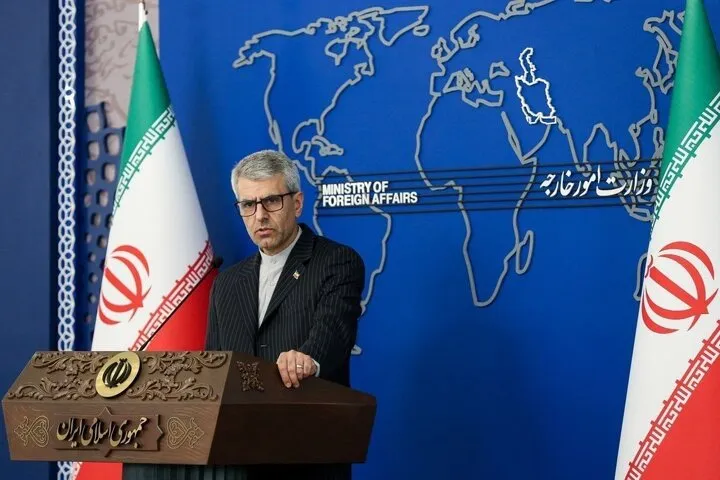
Tehran - BORNA - Esmaeil Baghaei made the remarks during his weekly press conference with journalists on Monday. He began by honoring the memory of the "Martyrs of Service," the late President Ebrahim Raisi and Foreign Minister Hossein Amir-Abdollahian, and also marked the birth anniversary of Khayyam, the great Iranian poet and scientist.
We are not enemies with any country in the region
In response to a question regarding reports about visits by Zionist regime officials to the UAE during the Ramadan War, as well as rumors concerning the active role of countries like the UAE, Jordan, and Bahrain in this conflict, Baghaei said: "We must not let such reports make us forget who the main threat and enemy in the region is. We are not enemies with any country in the region; we are permanent neighbors with them, including the UAE. Within this framework, we call upon and invite all regional countries to remain vigilant against foreign conspiracies—conspiracies aimed at creating division and rifts among regional nations, including Iran and the UAE."
The Foreign Ministry official noted: "Regional countries witnessed during recent developments that the U.S. military presence in the region does not bring security. Frequent travels between Israeli regime officials and certain countries in the region have existed and continue to exist, and this is not hidden from our view. However, the question remains: what has been the outcome of this normalization? It has achieved nothing except making Israel bolder in committing genocide against the people of Gaza, launching aggressions against Lebanon, and attacking a Muslim country by exploiting the territory of fellow Muslim nations."
The spokesperson added: "While we are highly critical of and hold demands toward neighboring countries that placed their soil at the disposal of the aggressors, we emphasize that sustainable security in the region requires the establishment of cooperation and efforts toward generating endogenous security by the regional countries themselves."
The U.S.-Bahrain resolution ignores obvious realities
Regarding the draft resolution proposed by the U.S. and Bahrain concerning the Strait of Hormuz, Baghaei explained: "This is the third attempt to draft a resolution. The first resolution that was passed was highly scandalous because it distorted the realities and made no mention of the aggressive parties. The second resolution, prepared by Bahrain and a few other countries, was vetoed by China and Russia, which was a highly responsible move. In recent days, talks of another resolution have emerged, which follows previous patterns and ignores obvious facts."
Emphasizing that the current situation in the Strait of Hormuz stems from aggressions carried out against Iran, he stressed: "The Security Council cannot hold Iran responsible for insecurity in the region."
The spokesperson continued: "We are in continuous contact with member states. We are also in touch with China and Russia. China and Russia know that the primary threat to maritime navigation is the United States. They themselves have admitted to acting like pirates. If the international community wants to take action, it must condemn the United States and the Zionist regime."
Iran-Oman expert meetings on the Strait of Hormuz are ongoing
Further addressing the issue of the Strait of Hormuz, Baghaei stated that it is a highly vital waterway and that the security of shipping is of utmost importance to Tehran. "The current situation in the Strait of Hormuz is the result of law-breaking by the U.S. and Israel. We have adopted a set of measures for the security of shipping in this area, and these measures are aimed at maintaining security and are based on international law."
Baghaei concluded: "Regarding this matter, we are in continuous contact with Oman—as another littoral state of the Strait of Hormuz—and other relevant parties to guarantee a mechanism that fulfills the aforementioned objective and duty. Within this framework, a meeting of experts between us and Oman was held in Muscat last week, and contacts between Iran and Oman in this regard continue."
Legal processes to obtain compensation from the U.S. are time-consuming
The diplomatic apparatus spokesperson, in response to a question regarding obtaining compensation and filing lawsuits against the U.S., said: "Legal processes take some time and require continuity. The first task is documenting U.S. crimes, which began from the very first hours of the 12-day war as well as the recent war. On February 26 (Esfand 8), we registered a petition at the Iran-United States Claims Tribunal and filed a lawsuit against the United States."
He added: "This case has been registered, and the review stages are being pursued and processed. Regarding the recent developments, we have registered all human rights violations, including the Minab school attack, with international bodies. We are pursuing all these matters; for instance, we registered the attacks on hospitals with the World Health Organization (WHO), and it is under follow-up."
Regarding the components of Iran's new policy concerning the Strait of Hormuz, Baghaei said: "Reducing the issue of security arrangements to ensure safe transit in the Strait of Hormuz to a financial matter is a deviation from the main subject. Any littoral state of the Strait of Hormuz may charge fees for navigation services and environmental protection."
He emphasized: "The core issue is safe transit through the Strait of Hormuz and the preservation of Iran's territorial integrity and sovereignty. The fact that Iran and Oman thought of regulating this mechanism was due to events that occurred since February 27 (Esfand 9). This has both a legal and logical basis. Implementing this also entails costs that are recognized at the international level."
We do not get excited by their praise either
The Foreign Ministry spokesperson also commented on the media line regarding the U.S. defeat by Iran, saying: "What matters to us is our own assessments. Just as we do not fear the enemy's threat, we do not get excited by their praise either. We believe in our capabilities and adjust our future plans in confronting the enemy."
We received and reviewed a set of proposals from the Pakistani side
In response to another question, the spokesperson noted that "negotiations are ongoing and not temporary," stating: "After we presented the 14-point plan and the American side raised its considerations, we mutually raised our considerations. Despite the fact that the American sides publicly announced that Iran's plan was rejected, we received a set of amendatory points and considerations from the Pakistani mediator. Therefore, from the day after sending our viewpoints to the American side, we received a set of proposals from the Pakistani side, which have been reviewed over the past few days. As announced yesterday, our viewpoints have been mutually reflected to the American side. The process continues through the Pakistani mediator."
Baghaei said: "What can be said with certainty is that the issue of rights is not something we want to negotiate or compromise on. Iran's right to enrichment is recognized based on the NPT treaty, and there is no need for others to recognize this right for Iran, as this right exists."
The Foreign Ministry spokesperson, in response to another question regarding the selection of the new Prime Minister of Iraq and its impact on bilateral relations, congratulated the formation of the new Iraqi government and said: "Relations between Iran and Iraq are deep and deep-rooted, and changes in governments do not affect the good relations between the two countries."
The attack on the Iranian border guard vessel by Kuwait and the allegations raised do not align with the principle of good neighborliness
Concerning the recent Kuwaiti attack on an Iranian vessel and the detention of Iranian citizens, along with the latest updates on their fate, Baghaei emphasized that "this action is unacceptable and entirely inappropriate," adding: "The atmosphere created in connection with this matter is incomprehensible to us. The relations between two neighboring countries require that if there is an issue, it should be conveyed through diplomatic channels."
Baghaei continued: "The attack on the Iranian border guard vessel and the allegations raised in this regard do not align with the principle of good neighborliness. We expect the Kuwaiti side to provide the ground for the release of Iranian citizens as soon as possible and not fall captive to the clichés raised by certain parties over the past two or three months."
The Foreign Ministry spokesperson also commented on the U.S. economic pressures and threats against Iran, saying: "One of the tools of U.S. threats is economic pressure; you saw well, and they saw too, that this economic tool and threat does not work against Iran and cannot dissuade us from pursuing our inherent rights. At the same time, we monitor the opposing side's movements and are certainly prepared for any eventuality. At the negotiation table, independent of these threats, we strive to realize Iran's national interests."
Baghaei stressed: "In the event that the slightest mistake is committed by the opposing side regarding Iran, we know very well how to respond to it, and you can hear this response clearly these nights from the mouths of the people in the streets."
In response to a question about Iran's relations with Arab countries, he said: "Mr. Araghchi's first trip after the recent developments to an Arab country was to Oman. Therefore, we are in continuous contact with the countries of the region and are determined to continue our relations based on good neighborliness and respect for each other's sovereignty. Of course, we realize that due to the complicity of some regional countries with the aggressors, we have suffered wounds, but we are eternal neighbors, and any rift in relations leads to exploitation by the Zionist regime."
Relations with China are so important that they must be decided with a macro perspective
The diplomatic apparatus spokesperson further commented on the appointment of Mohammad Baqer Ghalibaf, the Speaker of the Parliament, as "Iran's Special Representative for China Affairs," saying: "We have always had a special representative for China. Previously, the martyr Larijani was responsible for this matter, and now Dr. Ghalibaf has assumed this responsibility, which indicates the importance we attach to relations with China. We believe that relations with China, especially given international developments, are so important that it is necessary to make decisions with a macro perspective and pursue the country's interests."
Our armed forces have new surprises for the enemy
The Foreign Ministry spokesperson, in response to the question of whether he believes war will break out again between Iran and the U.S. and whether this matter will be managed and resolved through smart diplomacy, addressed the reporter saying: "Are you asking me for an analysis?"
He nonetheless continued: "Have no doubt that our diplomacy, 'Iran's' diplomacy, is smart, and we pursue this matter with seriousness. We are not going to be overwhelmed by the contradictory behaviors and threats of the opposing side."
The spokesperson added: "We are prepared with all our power for any scenario, and in the event that a crazy act is committed by the opposing side, we will respond with all our strength, and our armed forces will certainly have new surprises for the enemy."
It is a question for us too as to which actor in the region carried out the attack on the South Korean ship
In response to a question regarding yesterday's phone conversation between the foreign ministers of Iran and South Korea and reports indicating that one of the topics of this consultation from the South Korean side was the attack carried out on its ship in the Strait of Hormuz, he said: "I think yesterday's conversation is the third or fourth phone call held between the foreign ministers of Iran and South Korea over the past 50 to 60 days."
Baghaei noted that we have good bilateral relations with South Korea, stating: "This country has its concerns regarding maritime navigation security, and we are in contact and consultation with each other in this field. Regarding the incident that occurred, it is a question for us too as to which actor in the region carried out this act. This question was raised regarding this matter since the beginning of the incident, and we also emphasize that this matter must be investigated."
He Telegram-continued: "All countries must consider the point that some parties in our region spare no effort to escalate insecurity, and false flag operations should not be ignored, as this is something that has happened repeatedly."
It is unacceptable for visas not to be issued for some members of the national football team under self-made pretexts
The Foreign Ministry official further commented on reports regarding U.S. obstruction in issuing visas for some members of the Iranian national football team to participate in the 2026 FIFA World Cup, emphasizing that the decision for the national team's participation in the World Cup was made based on various assessments carried out by the entity in charge, namely the Ministry of Sports and the Football Federation. He added: "Issuing visas for the presence of the Iranian national football team and the technical staff, according to FIFA rules, is the duty of the host governments. Here, FIFA is our counterparty. Two days ago in Turkey, a good meeting was held between federation officials and FIFA directors. We were assured that all efforts will be made so that FIFA regulations are respected by the hosts. There is no doubt that the U.S. has repeatedly violated its hosting obligations, and the talk being split that they might not issue visas for some members of the national team under self-made pretexts is unacceptable."
Baghaei noted: "The Football Federation is seriously pursuing the matter, and we will also deploy any assistance we can to ensure the successful presence of the national team in the World Cup."
In response to a question regarding what the Foreign Minister heard from the officials of China and India during his trips to these two countries, he said: "What they heard must be asked from themselves. I was not present in China and India. It is obvious that during Mr. Araghchi's trip to India, the focus was on topics related to BRICS. During the trip to China, the focus of the talks was on bilateral relations given the good ties with Beijing, and in the current situation, on the regional circumstances and the consequences of U.S. law-breaking, as well as cooperation between Iran and China at the level of the United Nations and the Security Council."
The Foreign Ministry spokesperson emphasized: "We must forcefully continue our contacts with China and Russia as two members of the Security Council who hold a significant responsibility in maintaining international peace."
In negotiations with the U.S., our focus remains on ending the war
The Foreign Ministry official also commented on what was raised by Trump under the title of a "20-year suspension of Iran's enrichment," saying: "Regarding nuclear issues, we have stated our positions clearly. Our focus now is on ending the war. Regarding the nuclear issue, we emphasized that we are not going to deviate from our rights according to the Non-Proliferation Treaty (NPT)."
He emphasized once again that we are not currently negotiating nuclear details and are focused on ending the war.
Receiving war damages is a logical demand
The Foreign Ministry spokesperson, continuing the press conference, stated regarding the amount of damage inflicted in the war: "Do economic entities have the competence to express opinions? Assessments have been made and the matters are under review. Some cases become clear over time. During my trip to Kurdistan, I faced the crimes of the aggressors against Iran's historical and cultural monuments. Can damage to history and culture be specified with numbers and figures? This is a matter being pursued continuously."
Baghaei noted: "Regarding the issue of compensation, this is a logical demand because an illegal war was imposed on us; therefore, the parties that committed these crimes must be held accountable. This is a matter we are pursuing."
In response to a question about Trump's comment stating that he does not care about the economic situation of the American people, and Araghchi's tweet in this regard, and whether advice to such a person has an effect, he said: "This view is based on what we said before, that we have no fight or enmity with the American people. This is a war imposed by the U.S. government, which has imposed heavy costs on American citizens."
The Iranian Foreign Ministry spokesperson noted: "The fact that American officials have said economic costs do not matter to them is a clear contradiction, because previously they said this war was due to the threat of Iran, and later they said it was to support Israel. This contradictory rhetoric shows that this war was solely for the sake of the Zionist regime, and American officials must answer to their citizens and global public opinion, as it has imposed costs on all people of the world."
Baghaei, regarding China's stance on the Strait of Hormuz and Iran's nuclear program and the remarks raised in connection, said: "We have no disagreement with China in this regard. Regarding the nuclear issue, have we ever pursued a nuclear bomb? Regarding safe transit through the Strait of Hormuz, have we caused this situation to take shape? The reason we insist on adopting arrangements for the safe transit of shipping through the Strait of Hormuz with the help of Oman according to international standards is to prevent recent incidents. The party that has obstructed transit in open waters and attacks ships like pirates is the U.S., and China, because it has a large economy, has the right to demand maritime navigation safety from the U.S."
If a plan is proposed regarding regional security, we welcome it
The Foreign Ministry spokesperson, in response to another question stating that Saudi Arabia has reportedly proposed concluding a non-aggression pact with Iran while U.S. military bases still maintain a presence in that country, said: "I cannot say that a specific plan has been presented. But it is clear that all countries in the region, given the recent developments and the insecurity created by the U.S. and the Zionist regime in the region, may think about their defensive topics and make certain revisions in connection with them."
Baghaei continued: "We emphasize that regional security must be established based on mechanisms that regional countries reach a consensus on, and if a plan is proposed in this field, it will be welcomed by us."
The Foreign Ministry spokesperson, regarding the latest status of the approval of the legal regime plan for the Strait of Hormuz and the measures taken by the Ministry of Foreign Affairs in this regard, said: "Regarding what is related to the Foreign Ministry in this field, we are pursuing this matter in consultations with Oman. In relation to other sectors of the country, wherever necessary and wherever they ask us, including the Islamic Consultative Assembly (Parliament), we will present our viewpoints, and God willing, we will ultimately reach a conclusion that best secures the country's interests."
Continuing the press conference, in response to a question about the possibility of the U.S. betraying diplomacy multiple times and what the future outlook for diplomacy and dialogue in the world would be if Iran faces aggression again during negotiations, he said: "They have betrayed diplomacy enough, and they are currently witnessing the results. The U.S. is a party that is currently by no means considered a credible party at the international level. The contradictory views and conflicting statements of American officials, all of these have caused no country in the world to take the U.S. claims and gestures regarding diplomacy and negotiation seriously."
Baghaei stressed: "We too have participated in any diplomatic process related to negotiating with the U.S. with deep distrust and severe suspicion, in order to protect Iran's national interests."
The Foreign Ministry spokesperson emphasized: "Wisdom and prudence require that in any process, we must carefully consider past records and experiences and know that the U.S., with such a background, may repeat previous actions at any moment; however, this does not prevent us from participating in diplomatic processes with self-confidence, reliance on God, and confidence in the people's support."
Woe to 'informed sources'!
The senior Ministry of Foreign Affairs diplomat, in response to the question that we are witnessing the announcement of some provisions of negotiation proposals quoted by informed sources in the media—including the publication of the news of 5 U.S. conditions against 5 Iranian conditions, conditions that stand opposite to each other; the question is, what is the relationship of the efforts made by the Foreign Ministry to bring positions closer with these conditions that have been raised? Are these cases under the supervision of the Foreign Ministry or raised through other channels?—stated: "Woe to these informed sources. The phrase with which we describe our demands is not necessarily at the disposal of the negotiating team. The media may name a subject as they see fit or discern."
Baghaei stressed: "Our demands are clear. In relation to the issue of freezing Iran's assets, you may say it is Iran's 'condition,' but this is our 'demand,' and it is a rightful demand."
The diplomatic apparatus spokesperson noted: "We do not expect the opposing side to give us money; this demand is a right that has been wrongfully violated from Iran. Over the years, Iran's properties have been frozen in various banks, and Iran has no access to them. Or in relation to the subject of lifting sanctions, this has also been one of Iran's demands. Therefore, those cases that have been raised are Iran's demands, which are naturally pursued with seriousness by the Iranian negotiating delegation in any negotiation."
End Article