Baghaei: No discussions on nuclear details at this stage; focus is on ending war
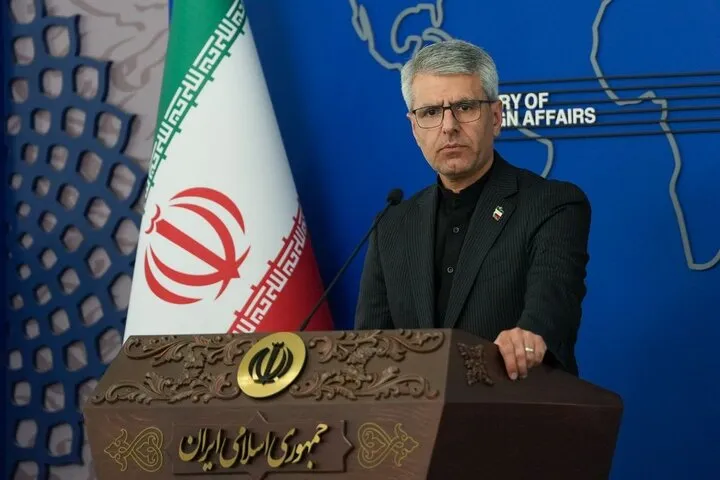
Tehran - BORNA - Esmaeil Baghaei, speaking on Monday morning at his press conference with reporters, commemorated the upcoming occasions of the 3rd and 4th of Khordad, stating: "The 3rd of Khordad is the anniversary of the liberation of Khorramshahr, which is a symbol of the Iranian nation’s invincibility, and the 4th of Khordad, named Dezful Day, is a symbol of the Iranian nation’s steadfastness against foreign aggression."
Pointing to the naming of Iranian missiles after Dezful and Khorramshahr, he noted: "Today is also an important day for the people of Lebanon; a day to honor the resistance that led to the liberation of southern Lebanon from Zionist occupation."
The diplomatic apparatus has a clear duty on the diplomatic field
In response to a question regarding the negotiations between Iran and the United States and the guarantees for its implementation by Washington, the spokesperson for the Ministry of Foreign Affairs of the Islamic Republic of Iran said: "Your guarantee is your power, and it is a lesson that the Iranian nation taught the aggressors. As for what the negotiating team's arrangement is, you should rather ask what the arrangement of the Iranian nation and the Islamic Republic of Iran is. The diplomatic apparatus has a clear duty on the diplomatic field."
Baghaei added: "The focus of the negotiations is on ending the war, and at this stage, we have no discussions regarding the details of the nuclear issue. Threats, pressures, and publishing political cartoons are part of the political theater on that side of the world. We pursue our work on the actual field of action."
The guarantee for the compliance of the opposing side is our own power
In response to another question regarding whether there is any guarantee for the implementation of commitments by the opposing side, he said: "No. The guarantee is our power."
Answering a question as to why Iranian officials do not react to Donald Trump's threatening tweets and statements, the foreign ministry spokesperson stated: "We have more important things to do. If we wanted to respond only to tweets, photos, and images drawn by the opposing side, we would not attend to our more important tasks. We are focused on designing and advancing the best methods to safeguard Iran's national interests."
He added: "We reply wherever necessary; we have our own style. We are not going to copy the enemy's style and methods. As a civilized, distinctive, and powerful nation, we will respond whenever we deem necessary and in whatever manner required, just as we have done so far."
Ceasefire on all fronts, including Lebanon, is included in the initial draft
Baghaei also emphasized that the issue of halting the war across all fronts, including Lebanon, has been incorporated into the proposed draft of the initial agreement.
In response to a question on whether any progress has been achieved during the Iran-US negotiations, the Iranian foreign ministry spokesperson said: "The developments of the past few days that became news are the product of several weeks of talks mediated by Pakistan, though other countries have also provided assistance in this regard."
Baghaei emphasized: "We have reached a conclusion on a large portion of the issues under discussion, which is a fact; however, if we want to say that the signing of an agreement is imminent, no one can make such a claim. As you know, policy-making and decision-making in the United States suffer from vacillation, and we repeatedly witness shifting stances from US officials and contradictory claims being raised by them; these issues cause the progress of any dialogue to face difficulties."
The Iranian foreign ministry spokesperson continued: "Just as we acted with power and authority on the operational field, we are also working in the diplomatic sphere with open eyes and taking past experiences into account to advance the interests of the Iranian nation."
Answering the question: "In the event of an agreement, will the Strait of Hormuz reopen, and what guarantee is there that US forces will not seize control of it after it reopens?", he said: "You possess power and you have demonstrated it. Do not worry about guarantees. A country that managed to defend itself for 40 days—and beyond—against two regimes armed with nuclear weapons and full capabilities, making the enemy regret its goals, can certainly demonstrate its power and authority moving forward."
No discussions on the details of the Strait of Hormuz in the agreement
He added: "We do not have any discussions regarding the details of the Strait of Hormuz within this agreement. The manner in which the Strait of Hormuz is managed is a matter related strictly to the coastal states of the waterway. We are also in contact with other countries to formulate a mechanism that guarantees safety and transit in the Strait of Hormuz, best serving the interests of the international community."
Regarding the new European sanctions against Iran in connection with the Strait of Hormuz and their impact, the Iranian foreign ministry spokesperson warned: "Any hostile action will face an Iranian response. You cannot unilaterally impose illegal measures and expect the opposing country to stand idly by."
He added: "Iran's hands are not tied. If Europe had taken a responsible stance long ago, perhaps some of the consequences facing our region and the global community today would not have occurred. If the European Union were truly committed to the values it slogans on this specific matter, it should have condemned the Zionist regime and the United States. Europeans must remember that the Strait of Hormuz was open prior to February 28, and it reached this state due to the aggressions of the US and the Zionist regime."
The Emir of Qatar did not visit Tehran
In response to a question regarding whether the Emir of Qatar traveled to Tehran, Baghaei stated: "The Emir of Qatar has not traveled to Tehran. Rather, the Deputy Secretary-General of Qatar's Supreme National Security Council visited Tehran. This visit took place within the framework of good offices and Qatar’s support to advance the understanding being brokered by Pakistan. The primary mediator of the talks is Pakistan, and some other countries have also played a positive role in resolving specific issues."
Regarding media speculation indicating that in the event of an agreement, Pakistan might announce the final statement with the consent of both sides without the travel of delegations, and whether he confirms this news or if there are plans for the Iranian delegation to travel to Pakistan or for a Pakistani delegation to revisit Iran, he remarked: "Formality issues are secondary to the substance and core of the matter. We are focused on the negotiation process. There is plenty of time to decide on how the understanding will be announced or signed. If necessary, further visits by delegations to Tehran or vice versa may happen, but under current circumstances, we have no scheduled plans for trips to Pakistan or for Pakistani officials to visit Iran."
We expect nothing from the Zionist regime except the destruction of any de-escalation process
Answering a question regarding the destructive role of the Zionist regime in a potential US-Iran agreement and the shifting stances of US officials following a phone consultation between Trump and Netanyahu, the diplomatic apparatus spokesperson said: "The Zionist regime is carrying out its specific mission. You cannot expect anything from this regime except the destruction of any process that could lead to a reduction of tensions in our region."
He added: "It appears that the definitive perception of certain warmongering factions, including the Zionist regime, regarding the US decision-making system and decision-makers is that they are easily manipulable, believing they can instill hesitation in their decisions through media hype to constantly alter them."
Baghaei emphasized: "A written or unwritten coalition exists between certain warmongering currents inside the US—both Republican and Democrat—and the Zionist lobby. This is not a matter restricted to recent days; it is a deeply rooted and well-known issue that has always worked to trap the United States in endless wars."
No transit fees collected in the Strait of Hormuz
In response to a question from an Australian journalist regarding the conditions under which Iran would reopen the Strait of Hormuz and allow ships to pass, and whether Iran wants to collect transit fees from countries, he noted: "We do not collect fees, and we are not seeking to collect transit tariffs. The measures taken by Iran and Oman to draft a protocol and mechanism to ensure the safe passage of ships are responsible actions entirely in line with international law."
He pointed out: "Naturally, the services provided during this process, including navigation services and measures taken to protect the environment in the Strait of Hormuz and the Sea of Oman, require the recovery of costs; therefore, no transit fees are being collected."
Baghaei emphasized: "Iran and Oman are working responsibly on this path, and we hope to reach a conclusion as soon as possible."
Facing US visa issuance issues
Addressing a question regarding the Foreign Minister's planned trip to New York to attend a UN Security Council meeting proposed by China, the diplomatic apparatus spokesperson stated: "I previously explained this trip and noted that we would decide based on priorities and conditions whether this trip takes place or not. Meanwhile, considering the collective set of circumstances, this trip will not take place; furthermore, we also encountered another issue, which is receiving the American visa."
Baghaei emphasized: "In any case, the Security Council meeting will be held tomorrow, Tuesday, and Mr. Araghchi will not be traveling to New York to attend it."
Regarding the recent visit of Kazem Gharibabadi to Muscat, the talks between Iran and Oman on managing the Strait of Hormuz, and Araghchi's verbal message to the Omani Foreign Minister, the foreign ministry official stated: "We understand that the security and safety of the Strait of Hormuz is a global concern, which places a heavier responsibility on us and Oman as the two littoral states of the Strait of Hormuz. This is exactly the reason for our concern; we must safeguard Iran's national security while also taking the international community's concerns into account. The reason Iran and Oman are working to establish a reliable and effective mechanism to ensure safe transit in the Strait of Hormuz is that we believe in utilizing this international waterway for free trade and safe navigation for all nations."
He stressed: "What happened in this Strait was the result of US and Zionist aggression, where this waterway was misused to attack a UN member state. Iran and Oman are working based on the principles and rules of international law to draft an efficient mechanism for managing traffic in this waterway. The Deputy Foreign Minister's trip to Muscat aligns with this objective. We are in contact with other countries as well. Many countries have expressed strong dissatisfaction with the situation caused by the US and the regime during bilateral talks. Naturally, any responsible country welcomes the creation of a reliable and predictable mechanism for managing navigation in the Strait of Hormuz."
Regarding the torture and abuse of human rights activists by the Zionist regime's internal security minister on the "Samoud" fleet—many of whom were European citizens—and the duty of human rights bodies and European nations, Baghaei said: "The duty of the international community is clear. Condemning an individual with weak phrasing while ignoring the clear reality that this person committed these crimes within a structured system and regime is self-deception. We must realize that what Zionist ministers or officials commit against Palestine, Lebanon, and the entire region is part of a formulated, decades-long policy."
The foreign ministry spokesperson emphasized: "On this basis, if European countries truly want their actions to be deemed credible and responsible, they should impose explicit, meaningful actions against the entirety of the Zionist regime. Preventing any accountability of the Zionist regime in the Security Council only emboldens the Zionist regime to commit further crimes."
Consular Department is in contact with the Azerbaijani Embassy to transfer the diplomat's body
Continuing his press conference, he expressed regret over the incident involving the Consul General of Azerbaijan in Tabriz which resulted in his passing, extending condolences to the diplomat's family, and added: "The Consular Department of the Iranian Foreign Ministry has been and remains in contact with the Azerbaijani Embassy in Tehran and the Foreign Ministry of Azerbaijan to assist in the repatriation of this Azerbaijani diplomat’s body, and we will do everything necessary to assist in this process."
In response to the question that the 11th NPT Review Conference ended without a final document for the third consecutive cycle, and what Iran's assessment of the failure factors is, he stated: "I think two primary factors exist. The first factor is the insistence of nuclear-weapon states in refusing to implement their commitments under the NPT. This is a constant pattern, particularly by the US, UK, and France, who continuously evade their obligations. Conversely, they have taken highly dangerous actions regarding nuclear proliferation and the distribution of atomic weapons globally."
Baghaei clarified: "The second point is the role of the Zionist regime. One of the demands of the international community regarding the Middle East region is the establishment of a nuclear-weapon-free zone. Unfortunately, during every disarmament review conference, the US blocks any resolution that would oblige the Zionist regime to surrender its nuclear weapons, accept international obligations, and comply with disarmament rules. Meanwhile, a third factor emerged this year, which was the refusal to acknowledge a clear reality—namely the US and Zionist aggression against Iran's peaceful nuclear facilities. Unfortunately, up to this moment, this clear fact has not been accepted at the level of the Board of Governors, the Security Council, or other international bodies, and the aggressors have not been condemned or held accountable."
Proposals by other countries regarding the Strait of Hormuz lack legal basis
Regarding reports of proposals by certain European countries, including Britain, to manage the Strait of Hormuz, and whether countries other than Iran and Oman are participating in drafting the relevant protocol and mechanism, he stated: "Is there any neighboring country around the Strait of Hormuz other than Iran and Oman? It is the sole responsibility of Iran and Oman to take the necessary measures, and we are currently doing so."
In this connection, Baghaei emphasized: "Other initiatives that you hear about, which lack any basis and are subsequently denied, merely complicate the situation. We remain in contact with other nations, and many have welcomed the swift implementation of this mechanism."
Relocation of the national football team's camp coordinated with FIFA
In response to a reporter's question noting: "Last week I asked you about the potential carghani (sabotage) of the Americans in issuing visas for the national football team members to attend the World Cup. You replied that our counterpart is FIFA, not the US. However, Mr. Taj, President of the Football Federation, announced that due to visa issues created by the US, the team's camp was relocated from the US to Mexico, which was also approved by FIFA. This shows that even FIFA could not take effective action against potential US visa sabotage. Given that the national team must be on US soil to play the matches, there are concerns that the Americans will sabotage other matters. What actions has the Foreign Ministry taken, and has it secured the necessary guarantees to prevent any unconventional actions by the US against Iran's national football team?", Baghaei stated: "My remarks do not contradict Mr. Taj's statements. We emphasize once again that our counterpart is FIFA."
He stressed: "The travel of Iran's national football team has no objective other than participating in the World Cup matches. The organizer is FIFA, actions are taken based on FIFA rules, and the United States, along with the two other host nations, is responsible for holding these matches. Within this framework, the US is obliged to provide all necessary conditions for the seamless presence of Iran's national football team. The decision taken by the Football Federation, as far as I am informed, was in full coordination with FIFA, the Mexican Football Federation, and relevant American counterparts to prevent any issues for Iran's national football team."
Baghaei noted: "Therefore, all these matters are conducted within the framework of football regulations and with FIFA’s responsibility to facilitate the national team's participation in mind."
Responding to a question regarding claims made by the Cuban-born US Secretary of State that the Iranian government spends its money on missiles and drones instead of improving citizens' lives, and whether these remarks align with US moves toward a new understanding, he said: "I think even the stones of Minab break out in hives upon hearing such brazen words from American officials who, after nearly 73 years of hostile actions against the Iranian people and development, still claim compassion and pretend to be upset that Iran's money is allegedly spent on drones."
He continued: "Yes, absolutely! We spend a portion of our money on missiles and drones, because if we hadn't, our enemies could have achieved their ambitions; just as we witnessed their repeated attempts in recent months. Regarding their remarks on Iran's development, I draw your attention to recent events. In their 40 days of military aggression against Iran, the Americans did not target only women, children, and men; they attacked Iran's infrastructure, which was the symbol of Iran's indigenous development. Were the steel industries, pharmaceutical industries, bridges, and power plants—which apparently are a thorn in the flesh of American officials who constantly threaten attacks—built with anything other than this nation's money? This deceptive rhetoric is merely aimed at diverting attention from the core issue and evading accountability for their crimes."
In response to a question regarding Mohsen Rezaee's remarks on the possibility of Iran exiting the NPT, the foreign ministry spokesperson clarified: "Regarding matters linked to Iran’s membership or suspension of membership in international treaties, the decision-making mechanism is clear. Whenever a decision is made in this regard, its implementation is a binding command for us at the Ministry of Foreign Affairs."
China has played a constructive role in all processes related to nuclear talks
Regarding China’s role in the diplomatic track underway between Iran and the US, Asim Munir's trip to China, and reports that parts of the text are based on an initiative presented by China, Baghaei stated: "China, as a country with which we share very good relations and a 25-year comprehensive strategic partnership agreement, has played a highly constructive role in all processes related to Iran's nuclear negotiations. Within the Security Council, China and Russia have also played a significant role."
Takht-Ravanchi holds talks with Chinese and Russian Ambassadors in Tehran
He continued: "During the negotiations, we remain in continuous contact with China and Russia. Yesterday, an important meeting was held between Mr. Takht-Ravanchi, the Political Deputy of the Iranian Foreign Ministry, and the ambassadors of China and Russia in Tehran, where the latest trends related to the diplomatic process between Iran and the US were discussed. If you recall, some time ago, the Chinese President presented a valuable four-point initiative for establishing regional peace and security, which has always been considered by us. During Mr. Araghchi’s trip to Beijing, cooperation between Iran and China, particularly focusing on restoring peace and security in the Persian Gulf and the Strait of Hormuz, was reviewed. Therefore, China has always played a highly constructive and useful role in this process, and these contacts will definitely continue."
Continuing his press conference, in response to a question on how he assesses current efforts by regional countries, including Turkey, to end the war, and whether Lebanon will be part of a potential agreement, he stated: "Halting the war on all fronts, including Lebanon, will be one of the elements of a potential understanding."
The spokesperson for the diplomatic apparatus of the Islamic Republic of Iran also noted: "Regarding the role of regional and neighboring countries in preventing escalation and reaching an understanding, we appreciate the role of all these countries. Turkey, as a neighboring nation, has always made valuable efforts on this path, and we are grateful to our Turkish brothers in this regard."
Perhaps the Israeli Prime Minister wants to become the US President!
In response to a reporter's question regarding Trump's remarks in an interview where he stated he might move to Israel after his presidency ends to run for Prime Minister, he told the journalist: "If you want my personal opinion, I think the reverse is also possible; perhaps the Israeli Prime Minister wants to become the US President."
The foreign ministry official added: "The nature of the relationship between the US and the Zionist regime is entirely clear. Everyone has seen that the sole concern of the US, or at least this administration, in the West Asia region is the Zionist regime, and it places no value or importance on regional security, peace, stability, or the economic prosperity of regional nations."
An abnormal entity cannot be normalized through normalization projects
Regarding reports that Trump has pressured Gulf Arab nations to join the Abraham Accords if they desire peace with Iran, Baghaei noted: "Setting conditions for regional countries regarding matters linked to Iran is an attempt to divert public opinion from the core issue. The core issue is that the Zionist regime is the sole and exclusive driver of insecurity in the region. An abnormal entity cannot be normalized through projects like normalization."
He added: "The reason this entity is abnormal is its behavior. Any party in the region that holds even a modicum of authenticity would not butcher a nation with such ferocity. The genocide in Gaza demonstrated that the Zionist regime itself does not believe it belongs to the region. Therefore, schemes like normalization are effectively imposing an unrealistic, unauthentic entity on the region; an action whose consequences will be felt by the entire region and the world. Unfortunately, the situation we face today is a clear example of the outcomes of the Zionist regime's actions supported by the US in the West Asia region."
In response to another question regarding the negotiations, he stated: "We have not set a specific timeline or date for finalizing the agreement. Certainly, as the Islamic Republic of Iran, we will not hesitate to reach a conclusion that safeguards the national rights and interests of Iran and its people as quickly as possible. For us, the benchmark is safeguarding national interests, and during this process, whenever necessary and whenever we reach a final conclusion, we will certainly announce it."
Regarding the negotiation progress, the Iranian foreign ministry spokesperson said: "I can say that everyone is working, and efforts continue on certain issues that have not reached a conclusion. At the same time, we must remember that the opposing side's negotiation model—if we may loosely use the word negotiation to describe their behavior—is unconventional. Their frequent shifts in stance and contradictions require no explanation from me; you can simply look at the tweets published by US officials to see the situation we face and the conditions under which we must advance the diplomatic track. This situation creates its own specific obstacles, but I assure you that your negotiators, keeping all aspects in mind, especially the experiences of the past year, will work to safeguard Iran's national interests in the best possible manner."
Answering another question regarding the Strait of Hormuz, Baghaei stated: "We must be precise in using words. 'Right of transit' and such expressions used by some media are inaccurate. Our priority is creating mechanisms to manage traffic in the Strait of Hormuz. This is the main topic. Collecting amounts for services provided or in exchange for services rendered is an important and entirely natural topic."
Messages currently exchanged between Iran and the US via Pakistani mediator
Regarding the date of the next round of Iran-US talks, he said: "Whenever we reach a final conclusion and deem it necessary to conduct face-to-face exchanges with the participation of the Pakistani side, it will happen. Currently, the exchange of messages between Iran and the US is being conducted through the Pakistani mediator, and no need is felt to hold such a meeting."
In response to a question regarding remarks by US Secretary of State Rubio about the Strait of Hormuz, claiming that Iran intends to create a new norm or nationalize the Strait of Hormuz, he stated: "I think the best advice to American officials is not to speak about creating new norms. Attacking a UN member state, violating a country's territory, and slaughtering its people—are these new norms or violations of existing norms? This conceptualization and phrasing by US officials is deliberately aimed at misleading public opinion."
The foreign ministry spokesperson clarified: "Fundamentally, the term 'nationalization' is meaningless here. The measures taken by Iran and Oman as littoral states align with the public interests of the international community, safeguarding the national security and interests of the two coastal nations, and preventing security threats imposed by the US and other sides who might repeat such actions in the future; actions witnessed during these past 40 to 50 days or the last three to four months. Therefore, these measures are conducted entirely responsibly within the framework of international law to protect free trade and international navigation."
The Foreign Ministry performs its duties flawlessly in decision-making and implementation
In response to a question noting that some analysts believe Iran's foreign policy has recently been influenced more than ever by security and field considerations, leaving the Foreign Ministry with the role of merely announcing decisions, and whether diplomacy in Iran today is a decision-maker or a decision-announcer, he said: "Some analysts may hold different perceptions and analyses, but I think any fair analyst witnesses how the diplomatic apparatus works to protect Iran's national interests and security."
Baghaei emphasized: "The Ministry of Foreign Affairs fulfills its national role, duty, and mission during the decision-making process, and once a decision is made, it considers itself obliged under legal procedures to implement those decisions in the best possible way. Therefore, the Ministry of Foreign Affairs participates in the decision-making process and performs its duties flawlessly during the implementation phase."
Regarding Iran's mediation to peacefully resolve tensions between Pakistan and Afghanistan, he said: "At this stage, we are focused on ending the war in the region. The issue of tension between neighbors is certainly important to us. We have repeatedly declared that we will not hesitate to take any action we can to eliminate tension and reduce hostility between Afghanistan and Pakistan."
The naval blockade must stop in the very first stages of a potential agreement
Regarding media reports detailing the Iran-US agreement, the diplomatic apparatus spokesperson stated: "Many details raised in the media are mostly a combination of speculation along with certain leaks provided by the opposing side or possibly other parties regarding the negotiation content. What is clear is that this is a 14-point memorandum of understanding focused on ending the war, the issue of the Strait of Hormuz, and lifting or ending the US maritime piracy against Iranian shipping, with clear regulations being anticipated."
Baghaei clarified: "Certainly, in the very first stages, US actions under the title of a naval blockade must stop, and concurrently, the Islamic Republic of Iran will take the necessary measures for safe transit in the Strait of Hormuz, the method of which concerns us as the littoral state."
Regarding internal rifts within the US administration, Zionist lobbying, and claims by US officials about negotiation progress and having no rush to reach a deal, the Iranian foreign ministry spokesperson stated: "There is no doubt that there is disarray in US decision-making. You face a wave of dismissals, contradictory remarks, congressional opposition, and opposition from segments of public opinion regarding the US administration's performance. This situation has naturally provided the ground for certain foreign parties, including the Zionist regime, to exert influence on the decision-making process in the US and carry out destructive actions. This matter concerns the US administration, but what is observed as the outward manifestation of this disarray is these contradictory statements, and this situation both undermines US seriousness in diplomatic tracks and makes work highly difficult for mediators."
Iran rules out no option in defending itself
Continuing the briefing, in response to a question asking whether Iran’s previous warning—stating that in the event of any mistake by the enemy, the spillover of war beyond the region is inevitable—remains in force or has been taken off the table amid negotiation progress, he clarified: "The Islamic Republic of Iran rules out no option in defending itself. Fundamentally, you cannot confine fire to one region or one country. If a fire breaks out, it is natural to expect its flames to engulf other areas and sectors."
He continued: "I am not stating this as a threat. Our armed forces are in a position to state their stance on the manner of response, and these stances have been declared."
The foreign ministry official added: "This matter is the result of US and Zionist regime actions. During the war, the reason fire spread to the region was nothing other than the US and the Zionist regime utilizing the territory of regional countries."
In this connection, Baghaei noted: "Unfortunately, some regional countries disregarded the compassionate and responsible warnings of the Islamic Republic of Iran against placing their territory and domain at the disposal of the aggressors. In the future, the matter is entirely clear; our armed forces do not speak much, but they will demonstrate in practice that in the event of any enemy error, the response to the aggressors this time will be with greater intensity and scope."
In response to a question pointing out that Americans state in their media that an initial understanding exists followed by 60 days of continued negotiations to reach a final agreement, and whether this is the case or if everything is on the table with the nuclear issue entering negotiations later, he said: "Regarding the 60-day topic, the basis of work is that if this memorandum of understanding is finalized, talks will be conducted within 60 days regarding certain details related to it as well as topics clarified within the text of the memorandum. Naturally, one of the subjects to be discussed during this timeframe is nuclear-related issues. I have repeatedly emphasized that at this stage, details of the nuclear issue will not be discussed under any circumstances. This 14-point memorandum of understanding is focused on ending the war, and if this occurs, nuclear-related topics will also be discussed within a 60-day period."
Regarding the International Criminal Court issuing an arrest warrant for the Zionist regime's finance minister for crimes against humanity and its impact on the legal prosecution and execution of justice regarding other Zionist officials, Baghaei stated: "This is not the first warrant raised against Zionist regime officials in the International Criminal Court. The case opened regarding the genocide of Palestinians both in the International Court of Justice and the International Criminal Court has unfortunately not reached a conclusion yet. The reason for this is clear, and that is US obstruction and insistence on continuing to grant immunity to the Zionist regime in committing its crimes."
He emphasized: "The credibility of the International Criminal Court and other human rights institutions has been severely tarnished in recent years. The reasons for this are inaction and indifference toward the crimes of the Zionist regime, as well as an inability to execute their own decisions. We hope that the international community and countries claiming to support the rule of law and justice take care, as continued appeasement toward the crimes of Zionist regime officials against the people of Palestine, Lebanon, and other nations will merely breed further distrust in international institutions."
End Article