Grossi’s Abdication of Duty: The IAEA’s Silence on Terror and the Erosion of Global Trust
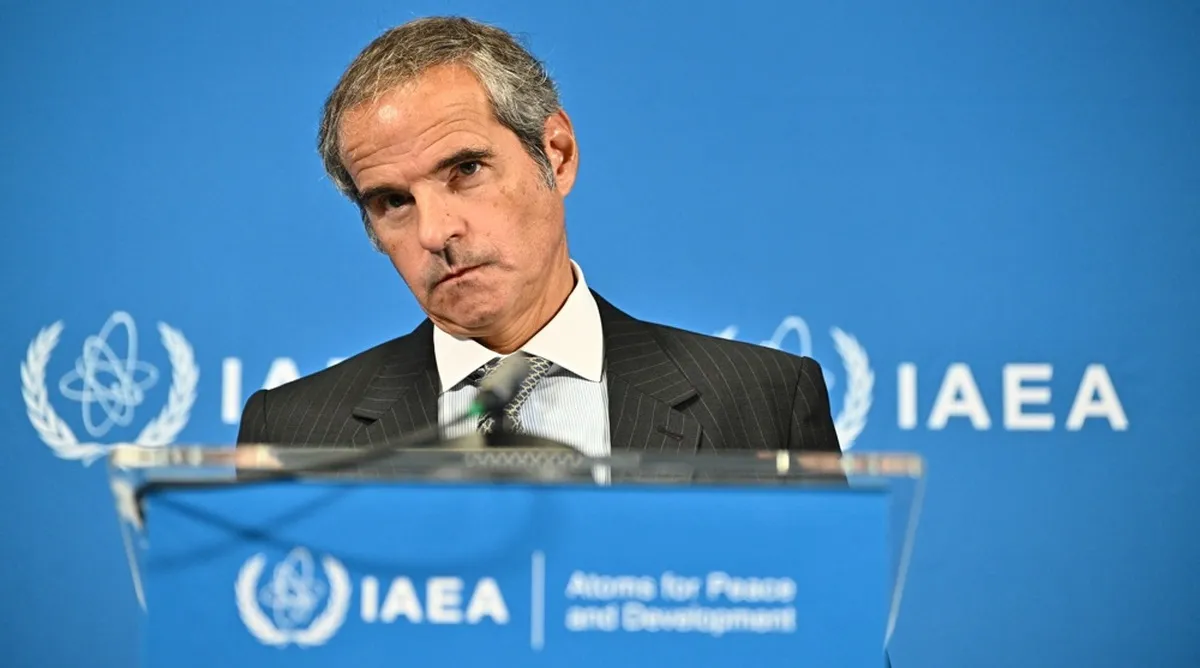
Tehran - BORNA - The International Atomic Energy Agency (IAEA) was founded to promote the peaceful use of nuclear energy, to prevent the diversion of nuclear materials for military purposes, and to serve as a neutral guardian of international law within the sensitive field of nuclear technology. Its legitimacy rests not only on technical competence but also on its impartiality and its commitment to the safety of those engaged in peaceful nuclear work.
Yet, with his latest remarks, Director General Rafael Grossi has undermined the very foundations of this legitimacy. When asked in Vienna whether he would condemn Israel’s targeted assassinations of Iranian nuclear scientists, Grossi declared: “I believe that this is not something that as director general of the IAEA falls within my purview.” He further added that he would not “condemn, rejoice, or endorse any physical act of violence,” dismissing the issue as a matter of “political criticism.”
This response is more than an evasion—it is an abdication of duty. By refusing to condemn acts of state terrorism against scientists engaged in lawful, peaceful nuclear activities, Grossi has not only betrayed the spirit of the IAEA Statute but has also legitimized a dangerous precedent: that political violence against members of the scientific community can be ignored, excused, or normalized.
Legal Obligations of the IAEA
The IAEA is not merely a technical body. Its Statute, adopted in 1956 and binding upon its member states and leadership, establishes broad responsibilities that transcend routine inspections. Article II of the Statute sets out the Agency’s objectives: “The Agency shall seek to accelerate and enlarge the contribution of atomic energy to peace, health and prosperity throughout the world. It shall ensure, so far as it is able, that assistance provided by it or at its request or under its supervision or control is not used in such a way as to further any military purpose.”
Article III further outlines that the Agency must “foster the exchange of scientific and technical information,” “encourage the exchange of training of scientists and experts,” and most importantly, “establish and administer safeguards designed to ensure that special fissionable and other materials … are not used in such a way as to further any military purpose.”
Embedded within these provisions is a fundamental obligation: the protection of scientists, experts, and facilities involved in peaceful nuclear activities. It is inconceivable that the IAEA could fulfill its mandate if its leadership treats the murder of scientists as irrelevant or outside its “purview.”
Furthermore, under Article XII of the Statute, the Agency is required to report to the United Nations in cases of non-compliance, and to ensure that member states abide by international norms. Acts of terrorism against nuclear scientists are not only violations of human rights—they are violations of the non-proliferation regime itself.
Violations of International Law
Israel’s repeated assassinations of Iranian scientists constitute grave breaches of international law. Under Article 2(4) of the UN Charter, all member states are prohibited from the “threat or use of force against the territorial integrity or political independence of any state.” Targeted killings on Iranian soil, directed against non-combatant civilians, are clear violations of this provision.
Moreover, Article VI of the Nuclear Non-Proliferation Treaty (NPT) obligates nuclear-weapon states to pursue disarmament and to respect the rights of non-nuclear-weapon states to develop nuclear energy for peaceful purposes. Iran, as a party to the NPT, has the explicit right to conduct research and to employ its scientists in civilian nuclear activities. To target these scientists is to directly undermine the NPT framework.
International humanitarian law, particularly the Geneva Conventions, also prohibits attacks on civilians. Scientists engaged in peaceful research are non-combatants. Their assassination is thus a violation not only of the laws of war but also of the most basic human rights protections enshrined in customary international law and the International Covenant on Civil and Political Rights (ICCPR).
The IAEA, as a specialized agency of the United Nations, has a duty under Article 57 of the UN Charter to act consistently with the purposes and principles of the UN. Silence in the face of these assassinations is therefore incompatible with the Agency’s obligations.
Grossi’s Double Standards
Grossi’s claim that condemning assassinations is “not within his purview” collapses under scrutiny. The Director General has never hesitated to speak in explicitly political terms when addressing Iran. He has endorsed resolutions critical of Iran, issued public warnings that “time is running out,” and repeatedly framed technical issues in a political context.
If Grossi can comment freely on Iran’s domestic legislation, its cooperation with inspectors, and its diplomatic posture vis-à-vis the E3 or the United States, then surely he can and must comment on acts of violence that directly undermine the Agency’s work. His selective neutrality exposes the political bias at the heart of his leadership.
This bias is not lost on the international community. For many states in the Global South, Grossi’s refusal to condemn terrorism against Iranian scientists reinforces a growing perception: that the IAEA has become less a technical body and more a political instrument of Western powers.
Iran’s Response and the Collapse of Trust
The Iranian Parliament’s unanimous vote in June to suspend cooperation with the IAEA was a direct consequence of this hypocrisy. The law stipulates that no inspectors may enter Iran until the security of its nuclear facilities and scientists is guaranteed—a requirement rooted in the fundamental principle of sovereignty and the state’s duty to protect its citizens.
This legislative move reflects a broader crisis of trust. Iran is not alone in perceiving that the IAEA has failed in its responsibilities. Many non-aligned states are increasingly skeptical of an Agency that seems quick to scrutinize some countries while remaining silent about the crimes of others.
If the IAEA loses the confidence of its members, the entire safeguards system risks collapse. States will be less inclined to grant inspectors access, less willing to share information, and less motivated to abide by rules that are applied selectively. The erosion of trust is thus not merely a political inconvenience—it is a threat to the stability of the global non-proliferation regime.
The Dangers of Silence
Grossi’s silence is not neutrality. It is complicity. By refusing to speak against assassinations, the IAEA sends a dangerous message to the world: that violence against scientists can be tolerated, that the rules of international law are negotiable, and that double standards are the norm.
This silence also emboldens aggressors. Israel has long acted outside the framework of the NPT, refusing to declare its nuclear arsenal and rejecting international oversight. The IAEA’s unwillingness to confront Israel on its illegal nuclear activities or its acts of terrorism only rewards defiance and undermines the rule of law.
Finally, Grossi’s position weakens the Agency’s moral authority. Without moral authority, the IAEA cannot function as a credible arbiter. Its reports will be dismissed as politically motivated, its resolutions ignored, and its inspectors treated with suspicion.
The IAEA at a Crossroads
The IAEA faces a defining moment. It can either uphold the principles of international law, defend the rights of its members, and protect the integrity of peaceful nuclear research—or it can continue down the path of politicization and selective silence.
Rafael Grossi’s refusal to condemn the assassinations of Iranian scientists is more than a personal failure. It is a symptom of a deeper malaise within the Agency. If left unchecked, it will accelerate the decline of global trust in the IAEA and erode the very system of safeguards that underpins international peace and security.
The message is clear: silence is not an option. The world is watching, and the credibility of the non-proliferation regime hangs in the balance.
End Article