Baghaei: We Continue to Witness Ceasefire Violations by the Zionist Regime in Gaza and Lebanon
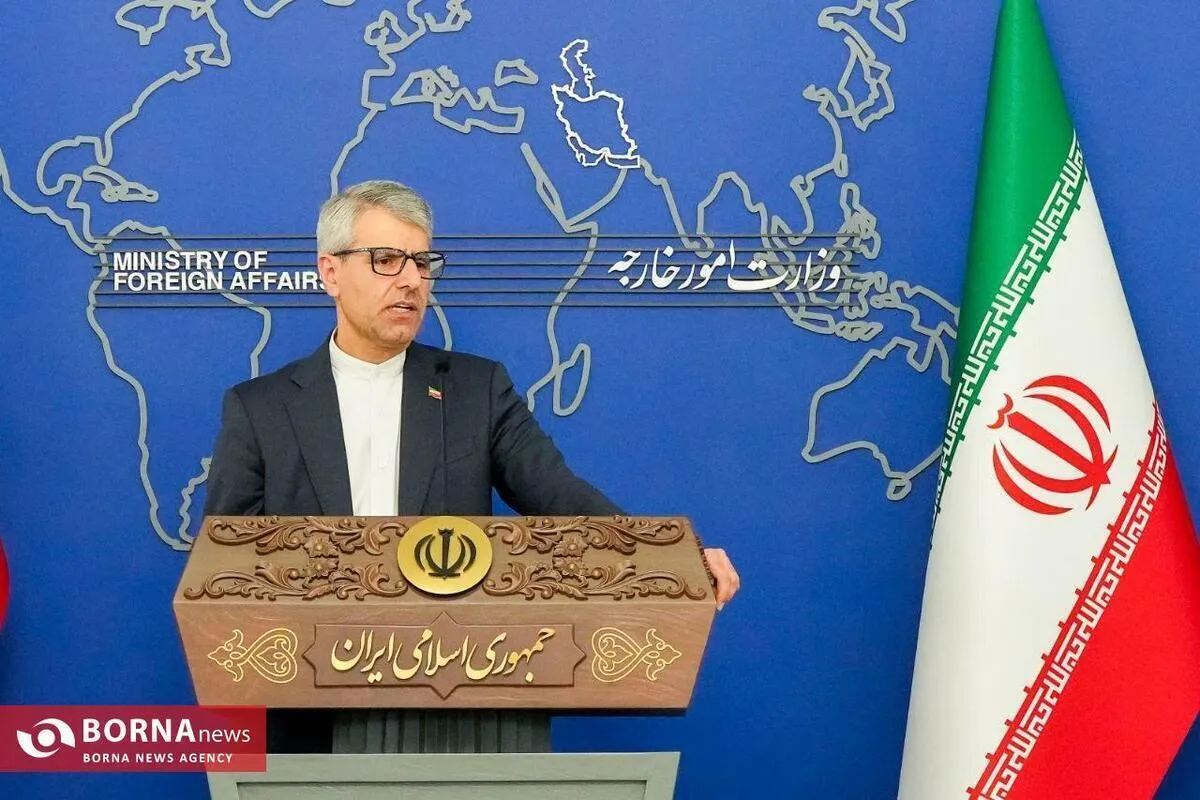
Tehran - BORNA - Esmaeil Baghaei, at the beginning of his press conference today (Monday), commemorated Parliament Day.
Referring to last week's diplomatic developments, including the recent visit of the Turkish Foreign Minister to Tehran, he said: "Yesterday, the Deputy Foreign Ministers of Saudi Arabia and South Korea also traveled to Iran and met and consulted with their Iranian counterparts and officials."
Baghaei also addressed developments in Lebanon and Gaza, stating: "Unfortunately, we continue to witness ceasefire violations by the Zionist regime in Gaza and Lebanon."
Saudi Deputy Foreign Minister’s Visit Continues Growing Trend in Tehran-Riyadh Relations
In response to a question regarding the recent visit of the Saudi Deputy Foreign Minister to Iran, the Foreign Ministry Spokesperson said: "The visit of the Saudi Deputy Foreign Minister to Iran took place in line with the continuation of the trend that began between Tehran and Riyadh about two years ago."
He added: "Relations between Iran and Saudi Arabia have been growing during this period, and this trip was in that same direction. During this visit, bilateral relations between Iran and Saudi Arabia were discussed, as well as regional issues, including Lebanon, Syria, Palestine, and others."
Baghaei noted: "This is a trend that both countries are determined to continue in order to strengthen trust and understanding among regional countries, advance regional goals, and help strengthen stability and security in the West Asia region."
Contacts and Consultations with the EU Foreign Policy Chief Have Always Been Maintained
In response to a question about the connection between the Foreign Minister's trip to France last week and a subsequent phone call between Mr. Araghchi and Ms. Callas, the EU Foreign Policy Chief, the spokesperson noted: "Last week, the Iranian Foreign Minister traveled to Paris at the invitation of the French Foreign Minister for discussions on a range of issues, one of which was the nuclear issue."
He continued: "On the other hand, our contacts and consultations with the EU Foreign Policy Chief have always been maintained, and I cannot say whether there was a connection between the two [events] or not, because the phone conversation between Ms. Callas and Mr. Araghchi was previously scheduled. It is natural that, given the Foreign Minister's visit to France, the discussions with Ms. Callas covered that trip and the consultations that took place during it."
Agreement Reached for Turkish President’s Visit to Iran
In response to a question regarding the Turkish President's trip to Tehran to attend the Supreme Council of Cooperation meeting between Tehran and Ankara, the Foreign Ministry Spokesperson said: "An agreement in principle has been reached regarding the conduct of this visit, and the two sides are currently consulting and negotiating on specifying the exact date of the trip."
Speaking of Iran's Intervention in Lebanon's Internal Affairs is Meaningless
The Foreign Ministry Spokesperson, in response to a question about claims by some Lebanese officials and media regarding Iran's interference in the country's internal affairs, noted: Mr. Araghchi has stated Iran's position on this matter. Speaking of Iran's intervention in Lebanon's internal affairs is meaningless, and we do not interfere in Lebanon's internal affairs. Issues related to Lebanon concern the Lebanese themselves.
The senior diplomat of the Islamic Republic of Iran noted: We understand the difficult situation in Lebanon. The country is neighbored by an occupying regime and is constantly being subjected to attacks by this occupying regime. We have always declared our solidarity with Lebanon, the Lebanese Resistance, and Lebanon's inherent right to stand against these aggressions.
The Iranian Foreign Ministry Spokesperson emphasized: The parties that interfere in Lebanon’s internal affairs are clear; they are the parties that dictate terms and set deadlines for various components of the Lebanese government.
Baghaei added: The Iranian government has shown that it has always pursued and will continue to pursue the path of friendship and support for Lebanon.
Australia's Action Against the Islamic Revolutionary Guard Corps Has No Legal or Factual Basis
The Spokesperson for the Ministry of Foreign Affairs of the Islamic Republic of Iran also responded to a question about Australia's action against the Islamic Revolutionary Guard Corps (IRGC), referring to the country's recent statement: The recent action by the Australian government has no legal or factual basis and is merely a continuation of the same approach adopted a few months ago, based on pretexts and false information induced by the security institutions of the Zionist regime. This action damaged the long-standing diplomatic relations between Iran and Australia and reduced the level of relations between the two countries.
He stressed: The Islamic Republic of Iran declared at that time that these accusations were completely baseless and ridiculous. Throughout this period, even official Australian authorities, including the state police in the Sydney region, have formally admitted that Iran had no involvement or interference in the alleged actions against Jewish targets. Therefore, it is clear that Australia's recent action was taken solely in line with paying ransom to the Zionist regime.
The Foreign Ministry Spokesperson added: The Islamic Republic of Iran invites all countries to be vigilant regarding the Zionist regime's attempts to undermine Iran's friendly relations with other countries. Recently, similar and baseless accusations have been made in Africa, similar to the unfounded claim made about Mexico, which was immediately rejected by official Mexican authorities.
The US Has Become the Biggest Threat to International Peace and Security Due to Its Recent Actions
The Spokesperson for the Ministry of Foreign Affairs of the Islamic Republic of Iran also emphasized, regarding recent US threats against Venezuela, including the closure of its airspace: The United States of America, through the behaviors it has demonstrated in recent years, has become the biggest threat to international peace and security.
Baghaei added: In various parts of the world, actions based on threats and overt force are observed from the US. In the Western Hemisphere, repeated threats against Venezuela, Cuba, Nicaragua, and even Brazil and Mexico have been reiterated by American officials. The closure or declaration of closure of a country's airspace is an unprecedented action contrary to all international norms and regulations, especially those related to aviation safety.
He continued: In the African continent, the US has also openly threatened, even declaring that some countries, such as South Africa, do not have the right to attend the G20 summit. US actions are also fully evident in our region: comprehensive support for the Zionist regime has practically turned the country into an accomplice to the regime in genocide, violation of national sovereignty, and territorial integrity of regional countries.
The Foreign Ministry Spokesperson noted: Under normal circumstances, the UN Security Council should address these US actions as a gross violation of international peace and security. Every single one of these actions is contrary to the most important principles of the UN Charter, which is the prohibition of the use or threat of use of force.
Baghaei warned: Unfortunately, US actions are becoming a model for some other international actors, a process that would mean the normalization of lawlessness at the global level. This situation entails direct harm and damage to all governments and the entire international community.
Araghchi Met with "Mahdieh Esfandiari" in France
The Foreign Ministry Spokesperson also responded to a question regarding whether Mr. Araghchi met with Ms. Mahdieh Esfandiari during his trip to France, and how he interpreted Mr. Araghchi's statement in an interview with France 24 that the prisoner exchange between Iran and France was in the national interest of the country: Part of Iran's national interest lies in supporting Iranian citizens in various parts of the world, and it is the inherent duty of the Foreign Ministry to support Iranians who have faced difficulties globally.
He added: During Mr. Araghchi’s trip to France, a meeting took place between him and Ms. Esfandiari. She was well, and we hope the process that has begun will lead to her freedom and return to the country as soon as possible.
Iran's Principled Position Is That Terrorism Is Condemned Everywhere
The Foreign Ministry Spokesperson, in response to a question regarding the Foreign Minister's statement yesterday that Iran supports the disarmament of the PKK group in Turkey, and referring to the importance of counter-terrorism, said: The principled position of the Islamic Republic of Iran is that terrorism is condemned everywhere.
He added: Terrorism in one area also leads to insecurity in other areas. Therefore, the respected Foreign Minister has emphasized that just as the Turkish government stresses the need for a "Turkey without terrorism," this view must be transformed into a more comprehensive "region without terrorism."
The Foreign Ministry Spokesperson added: Regional cooperation and interaction among relevant governments to counter and eradicate terrorism in all its forms must continue. In this regard, the two Foreign Ministers of Iran and Turkey agree that cooperation between regional countries must be strengthened more than ever before.
Our Embassy in Venezuela is Active / Our Relationship with the Venezuelan Government is Based on Cooperation and Mutual Respect
The Foreign Ministry Spokesperson also responded to a question regarding developments in Venezuela, including the current status of the Iranian Embassy's activities, whether Iran is granting asylum to Venezuelan officials, and measures Tehran has taken for the exit of its citizens from Venezuela: Fundamentally, I believe that the very posing of this question is insulting to the people and government of Venezuela, as there is no legal basis or reason for a country to infringe upon the self-determination rights of another nation and dictate terms simply based on bullying.
He continued: Our relationship with the Venezuelan government is based on cooperation and mutual respect, and we have repeatedly declared solidarity with the government and people of Venezuela because Venezuela is facing an illegal threat from the US that has no basis. The Americans have used the argument of countering drug trafficking from Venezuela as a pretext for their actions—a claim that has no basis according to international documents, and even if such a thing existed, it provides no basis in international law for the use of force.
Baghaei continued: Our embassy in Venezuela is active, and what should be a concern for the international community is to take serious action against the unilateral and aggressive actions of the US and not allow the pattern of using force against independent countries to become a threat and a procedure on the global stage.
Iran, as a Member of the NPT, is Determined to Exercise Its Rights
The Spokesperson for the Ministry of Foreign Affairs of the Islamic Republic of Iran, in response to a question about Iran's nuclear issue and whether Tehran has a plan to exit the current impasse, said: The position of the Islamic Republic of Iran regarding nuclear activities is completely clear. What Iran is doing is the utilization of a right granted to Iran and all member states under international law and the Non-Proliferation Treaty (NPT).
He added: The Iranian nuclear issue cannot inherently be an international concern; this matter was forcibly imposed on Iran, the region, and international bodies, including the UN Security Council and previously the IAEA Board of Governors, from the outset. Therefore, this issue fundamentally lacks any authenticity or relevance.
The Foreign Ministry Spokesperson noted: Talk of an "impasse" in this context is baseless. The opposing parties must refrain from implementing policies based on coercion and advancing demands that have no basis in international law or logic. The real solution is for Iran's right under the Treaty to be accepted—not as the granting of a new right, but as an agreement that Iran's existing rights will no longer be infringed upon.
He emphasized: The Islamic Republic of Iran, as a member of the NPT, has accepted obligations and is determined to exercise its rights as well. This point has been emphasized in all talks and negotiations with the opposing parties and will continue to be adhered to.
Joint Counter-Terrorism Drill Demonstrates Commitment to Coordinated Action
The Spokesperson for the Ministry of Foreign Affairs of the Islamic Republic of Iran announced regarding the counter-terrorism drill in the Northwest of the country: The joint counter-terrorism drill in the Northwest of the country is currently being held with the field participation of five countries and the presence of a total of 13 to 14 countries. This exercise demonstrates the importance the Islamic Republic of Iran places on coordinated and multilateral action against the menace of terrorism.
He noted: Terrorism is a cross-border problem that no single country can confront alone. Therefore, multilateral cooperation within the framework of regional and international arrangements can be a starting point for expanding interactions in various fields related to international security.
The Foreign Ministry Spokesperson stressed: The Islamic Republic of Iran hopes this cooperation will expand beyond counter-terrorism to include the fight against transnational organized crime.
Iran’s Continuous Consultations with the E3 and the European Union Will Continue
Regarding Iran's negotiations with the Western side, in light of the recent phone call between Mr. Araghchi and Ms. Kallas and consultations with the French Foreign Minister, the Spokesperson emphasized: The position of the Islamic Republic of Iran has always been clear; negotiation is meaningful only when the respective parties recognize each other's legitimate rights and concerns. Confrontational measures have always been the main obstacle to advancing negotiations. These actions were not taken by Iran, but rather by the European parties who, by introducing draft resolutions in the UN Security Council and the IAEA Board of Governors, blocked the natural course of negotiations.
He added: There are many examples of this behavior. Unfortunately, the three European countries, under US pressure, abandoned their commitments under the JCPOA and took actions that did not help the negotiation process at all.
The Foreign Ministry Spokesperson noted: Dialogue with a country does not mean the start of negotiations; dialogue is an inseparable part of diplomacy. The Islamic Republic of Iran has diplomatic relations with European countries and has always welcomed dialogue and the exchange of views. This is a fundamental characteristic of Iran's diplomatic apparatus, and it is natural that new paths will open up through these interactions and dialogues.
He concluded his answer by stating: The recent visit and phone call with Ms. Callas took place as a continuation of Iran's continuous consultations with the three European countries and the European Union, and this trend will continue.
The US is Considered the Biggest Destroyer of the Non-Proliferation Regime
Baghaei also responded to a question about US policies in the field of non-proliferation, stating: The United States of America is currently considered the biggest challenge to the preservation of the non-proliferation regime. The main reason for this situation is the policies based on double standards; such that the US turns a blind eye to a regime that possesses a vast array of weapons of mass destruction and simultaneously acts as the biggest impediment to realizing a West Asia free of nuclear weapons—namely, the Zionist regime, which, in addition, commits genocide and aggression against other countries.
He added: The US recently announced that it will resume nuclear testing, an action that is clearly contrary to its commitments in documents related to disarmament and arms control. Furthermore, US actions in destabilizing the world, including fueling the arms race in East Asia and daily threats against various countries, have induced a sense of international insecurity.
The Foreign Ministry Spokesperson noted: A clear example of the US violation of the non-proliferation regime was its illegal attack on Iran's peaceful nuclear facilities—an action that practically destroyed the credibility and standing of the NPT and the rights and privileges established by the international community for the member states of this treaty within the framework of international law.
He emphasized: It is natural that in such circumstances, a serious question arises for the international community: What is the benefit of adhering to the non-proliferation regime when the US, without any justified reason and with the accompaniment of the Zionist regime, attacks the peaceful nuclear facilities of countries? The reality is that the US is not only the biggest threat to international peace and security but is also considered the biggest destroyer of the non-proliferation regime.
US Contradictory Approach Shows the Nuclear Issue Was a Pretext to Pressure the Iranian Nation
In reaction to the contradictions in the United States' approach toward Iran, Baghaei stated: These contradictions are not logically or rationally justifiable and merely show that Iran's nuclear issue has been a pretext for the US to exert pressure on the Iranian nation.
We Condemn Actions Against the Gas Facilities in the Kurdistan Region of Iraq
The Foreign Ministry Spokesperson, in response to a question about recent attacks on gas fields in the Kurdistan Region of Iraq and whether Iran will take action to support Iraq against these attacks, given the security agreement between Iran and Iraq, noted: We express our concerns about the anti-security actions taking place in Iraq. The recent attacks on gas fields are absolutely condemned by us. We support any action to cooperate with the Iraqi side to ensure security in the region and across the border.
Baghaei reiterated: We condemn these actions against gas facilities. Our belief is that parties exist that seek to create a state of insecurity in the region. We must be vigilant about the movements of the Zionist regime, as this regime spares nothing to create insecurity in the region.
The Interruption in IAEA Inspections Resulted from Military Aggression and Criminal Acts by the US and the Zionist Regime
The Spokesperson for the Ministry of Foreign Affairs of the Islamic Republic of Iran, in response to another question, clarified: All of Iran's nuclear program has always been under the supervision of the IAEA, and the sites at Natanz, Fordow, and Isfahan have been continuously inspected.
He added: The interruption in the inspection process resulted from military aggression and criminal acts by the US and the Zionist regime. The Agency must hold these countries responsible and accountable. Unfortunately, the Board of Governors resolution did not even make the slightest mention of this reality, and they also prevented the issuance of a condemnation or even a simple expression of regret in the Security Council regarding this criminal act.
The Foreign Ministry Spokesperson noted: The Agency cannot claim a violation of commitment by Iran, especially concerning facilities that lack proper safety conditions due to military aggression and where there is a risk of radioactive leakage. Fundamentally, the Agency has no protocol for inspecting such sites, because in the history of this institution, there has been no precedent of safeguarded facilities being subjected to military attack.
Baghaei said: Iran engaged with the Agency in good faith and reached an understanding after three rounds of negotiations last September, which defined a framework for cooperation based on Parliamentary law and the Supreme National Security Council's decision. Unfortunately, the opposing parties did not value this process and undermined it with their actions.
No New Security Warning or Assessment Has Been Conveyed to Iran
The Foreign Ministry Spokesperson, in response to a question about the recent flights of the international coalition's fighter jets over Iraqi Kurdistan, reports on the possible presence of Israeli fighter jets in Iraq, and Netanyahu's recent remarks about "extraordinary events" occurring in the coming months, was asked for the Foreign Ministry's assessment of these signs of a potential new crisis, and whether any new security warning or assessment was conveyed to Iran during the visits of the Turkish Foreign Minister and the Saudi Deputy Foreign Minister. He noted: The answer to your second question is No.
Iran Considers It Its Duty to Maintain Full Preparedness Under All Circumstances
Regarding the visits of senior Saudi and Turkish officials to Iran, Baghaei stated: The recent talks with Turkish and Saudi officials were conducted within the framework of bilateral relations and consultations on regional and international developments. Naturally, in every conversation with regional parties, shared concerns about the continued warmongering and crimes of the Zionist regime are raised; this is a concern shared not only by the countries of the region but also by the Organization of Islamic Cooperation and the entire international community.
He added: The Zionist regime is inherently crisis-generating and has continuously injected crisis into its surrounding environment and the entire region for the past eight decades. For this reason, there is now more regional and global consensus than ever before regarding the threat to international peace and security posed by this regime.
The Foreign Ministry Spokesperson stressed: The Islamic Republic of Iran considers it its duty to maintain full preparedness under all circumstances. Utilizing the experience of the 12-day battle and the epic defense of the country's integrity by the Iranian nation, Iran is fully prepared with all its might and capacity to confront any eventuality and will not allow the sinister dreams of the Zionist regime for the destabilization of Iran to materialize.
The Iran–China Railway Project is Very Important for the Islamic Republic of Iran
The senior diplomat of the Islamic Republic of Iran, in another part of his remarks at the press conference, highlighted the importance of the Iran–China railway project in response to a question, saying: This route is very important for the Islamic Republic of Iran, and fortunately, all countries on this route share a common view on accelerating its implementation and operationalization.
He emphasized: Our colleagues in the Foreign Ministry and the Ministry of Roads are in continuous contact with the Chinese sides, and good discussions have recently taken place in this regard.
He expressed hope that this process will yield results in the shortest possible time and bring significant economic achievements for the country.
Europe's Repetition of the Phrase 'We are Ready to Negotiate' Does Not Change the Fact That They Are Not Ready
In response to a question about the tone of the French Foreign Ministry's statement after Araghchi's meeting in Paris last Wednesday, particularly the demanding phrase "Iran should return to the negotiating table as soon as possible," the Foreign Ministry Spokesperson said: The repetition of a statement that "we are ready to negotiate" does not change the reality that the opposing parties are not ready to negotiate. Being ready for negotiations or asking one party to "return to the negotiating table" raises the question: Return to which table? The European side, which refers to the US whenever negotiations are mentioned, shows that they themselves do not believe they can play an independent, responsible, and effective role in a diplomatic process; perhaps they lack the necessary capacity and confidence to fulfill their responsibilities.
He continued: Therefore, this statement, this phrase, should be viewed more as a matter of propaganda and public relations than a position backed by practical support, good faith, and seriousness.
We Are Obligated to Defend the Rights of Our Citizens
The Foreign Ministry Spokesperson, in response to a question regarding new restrictions imposed by the United States against citizens of several countries, including Iran, and Trump's order to review and re-examine the Green Cards of citizens from 19 countries, said: I will answer this question in two parts. As far as Iranian citizens are concerned, we are obligated to defend the rights of our citizens; just as we have endeavored to provide help and support wherever the rights of Iranian citizens have been violated.
He continued: Regarding the core issue, this matter is another manifestation of the prevalence of a racist viewpoint in the American governance system. It seems that the citizens of these countries—around 20 countries, if I'm not mistaken—have become a bargaining chip in the political disputes within the US. The fact that all previous decisions regarding an issue related to the fate of individuals are canceled simply due to the decision of a former president or another party signifies a disrespect and disregard for the fundamental human rights of these individuals. As I mentioned, this approach is another sign of a racist view toward countries and the citizens of other countries.
The Israeli Side is Not Loyal to Any Promise or Pledge
The Foreign Ministry Spokesperson, in response to a question about Iran's assessment of the ceasefire status in Lebanon on the occasion of its one-year anniversary, said: It is fundamentally well-known that Israel enters a ceasefire agreement in order to violate it, and experience shows the same. The UNIFIL spokesperson, an official UN representative, cited the figure of 10,000 ceasefire violations from last November until today, which is very telling; when a ceasefire is violated 10,000 times within this relatively short period, it practically means there is no ceasefire, and the Israeli side is not loyal to any promise or pledge.
He continued: The Zionist regime has only used this opportunity for more attacks against Lebanon, for assassinating Lebanese figures, for killing Lebanese citizens, and for disrupting the process of development and economic improvement in Lebanon; especially since many of the targets attacked by the Zionist regime were construction workshops or building material production sites. This is significant, as the Zionist regime is targeting not only the security and stability of neighboring countries but also the development and economic well-being of their citizens. This situation severely burdens the responsibility of the guarantors.
Baghaei stressed: Unfortunately, the ceasefire guarantors have not taken any worthy action to contain the gross violations of the ceasefire by the Zionist regime, and this further discredits the parties who have presented themselves as ceasefire guarantors.
Central Bank Governor's Visit to Afghanistan Was Coordinated with the Foreign Ministry
In response to another question about the Central Bank Governor's visit to Afghanistan, whether consultations were held with the Economic Diplomacy Deputy of the Foreign Ministry regarding this trip, and whether there is a plan to establish a joint bank between Iran and Afghanistan, the Foreign Ministry Spokesperson said: The visit that took place was an important one. Prior to that, good discussions had been held between the Economic Diplomacy sector of the Foreign Ministry and relevant Afghan parties. Our relationship with Afghanistan, as a neighbor and two countries with long borders, is important in various respects.
He emphasized: One of the important aspects of bilateral relations between Iran and Afghanistan is economic and commercial issues. Proposals have been raised in the past to strengthen this path by increasing cross-border traffic, establishing border markets, facilitating customs procedures, and providing facilities for exporting and importing goods.
Baghaei stressed: The recent visit of the Central Bank Governor was conducted within this framework, and there was full coordination with the Economic Diplomacy sector of the Foreign Ministry, and this coordination will continue.
Former CIA Director's Revelation in Tel Aviv About US Complicity with Al-Qaeda is Not New
In response to another question about the former CIA Director's revelation in Tel Aviv regarding US complicity with Al-Qaeda and ISIS in the fall of the Assad government, he noted: This revelation is not new. Previously, the former US Deputy Secretary of State during Joe Biden's term explicitly referred to such a thing, and the current US President has repeatedly referred to it, stating that the US itself created ISIS or was at least one of the parties that played a key role in the formation of Takfiri terrorism in our region.
Our Assessment of Developments Related to the 25-Year Agreement with China is Completely Positive
The Spokesperson for the Iranian Ministry of Foreign Affairs, in response to a question about Iranian Ambassador to China Rahmani Fazli's report at the recent session of the Parliament's National Security and Foreign Policy Commission regarding the implementation process of the 25-Year Comprehensive Cooperation Document with China, the need to emphasize inter-agency coordination, and the Foreign Ministry's assessment of the joint roadmap's update status, said: Our assessment of these developments is completely positive. The Iran-China cooperation agreement, as you know, has various components and sections. The implementation process has been appropriate so far, and fortunately, both sides are determined to continue this process.
Baghaei noted: For any document of this scope—a document that is intended to be the roadmap for cooperation between the two countries over a significant period, two or three decades—it is natural that during the implementation process, care must be taken to resolve any existing challenges or obstacles, and this is one of the positive aspects of the joint work currently being carried out by Iran and China.
Saudi Deputy Foreign Minister's Visit to Iran Was in Response to the Visit of the Foreign Minister's Special Envoy for Syrian Affairs to Riyadh
The Foreign Ministry Spokesperson, in response to an question about yesterday's visit of the Saudi Deputy Foreign Minister to Iran, the presence of the Foreign Minister's Special Envoy for Syrian Affairs at the meeting, and whether the trip was centered on Syria, and also addressing regional media claims that Iran and Syria are in contact through intermediaries or third countries, and whether Saudi Arabia is that intermediary, said: To speak technically about this visit, it was conducted in response to the recent visit of Mr. Sheibani, the Foreign Minister's Special Envoy for Syrian Affairs, to Saudi Arabia. All regional issues are important to us and are interconnected; the crises we unfortunately face in Gaza, Lebanon, Syria, and the entire region. But this trip was more focused on this specific issue (Syria), and during his visit to Tehran, the Deputy Foreign Minister met and consulted with the Foreign Minister's Special Envoy for Syrian Affairs, in addition to the Foreign Minister.
He continued: These consultations have existed before, as I mentioned. We have discussions about the issue of Syria not only with Saudi Arabia but also with other regional countries. Syria's security is important for the entire region. A common concern among the regional countries is the continuation of the Zionist regime's aggressions against Syria, as well as the ongoing occupation of parts of Syria, which we have recently seen expanding with the entry of Zionist regime officials. Therefore, consultation on developments in Syria is a permanent item on the agenda of the diplomatic apparatus with regional countries, including Saudi Arabia.
We Cannot Say that Saudi Arabia is an Intermediary Between Iran and the New Rulers of Syria
In response to a question about whether Saudi Arabia is an intermediary between Iran and Syria, Baghaei added: We cannot say that Saudi Arabia is an intermediary between Iran and the new rulers of Syria.
He emphasized: We naturally have discussions with all countries that are in some way connected to us and the opposing side (Syria), not with the aim of creating a channel, but with the aim of helping to improve the regional and security situation and, in any case, to be informed of each other's viewpoints regarding the way forward.
The Foreign Ministry Spokesperson concluded the press conference by meeting and consulting with a number of professors and students of International Relations from Kharazmi University and answering their questions.
End Article