Baghaei: Ending war, reopening Hormuz Strait prerequisite for any nuclear talks
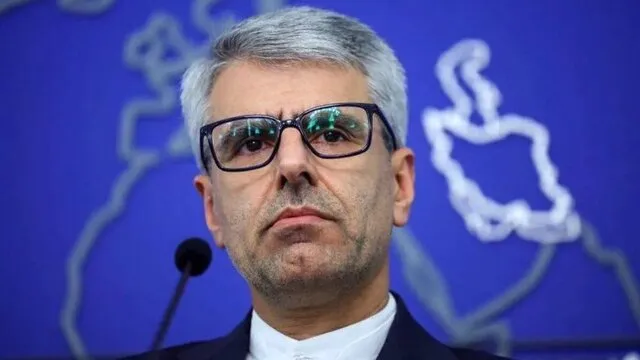
Tehran - BORNA - In an interview with India Today Global, Baghaei discussed the nuclear deadlock, the closure of the Strait of Hormuz, the aggressions by the U.S. and the Zionist regime, and Tehran's readiness to respond to any escalation.
Explaining why Iran rejected Donald Trump’s recent proposal, the spokesperson noted that the U.S. remains focused on coercion. He clarified that Iran's counter-proposal prioritizes an end to the war and the reopening of the Strait of Hormuz before any nuclear discussions can take place.
Baghaei highlighted that the United States has undermined nuclear negotiations twice in less than nine months. "Washington disrupted the process early last year and again on February 28, 2026. It was not Iran that left the negotiating table," he said, warning that this "failed formula" should not be repeated.
Addressing the situation in the Persian Gulf, the spokesperson asserted that the closure of the Strait of Hormuz is the fault of the United States. He explained that the waterway remained open until February 28, but Iran was forced to take reciprocal action after the U.S. and the Zionist regime used the territories of Persian Gulf littoral states to launch attacks against Iran.
Baghaei further noted that according to international law, a naval blockade is considered an act of war. He emphasized that Iran’s actions are a direct response to provocations and aggressions facilitated by foreign forces in the region.
Context of Iran-U.S. Relations and the Nuclear Standoff
Responding to a question regarding the points of contention between Iran’s proposal and the U.S. offer, Baghaei emphasized the need to view the situation through the lens of the past decade. He recalled that while the 2015 JCPOA was the result of years of negotiations, the U.S. unilaterally withdrew in 2018. "Iran waited for a year for European parties to compensate for the U.S. withdrawal, but as that failed to materialize, Tehran began gradually reducing its commitments in May 2019," he explained.
Baghaei also noted that despite deep-seated mistrust, Iran re-engaged in a diplomatic process through Oman during Trump’s second term at the request of regional leaders. However, he stressed that the U.S. "destroyed the negotiations mid-way through military aggression against Iran," an action he said was repeated on February 28.
Negotiation vs. Imposition of Will
The spokesperson stated that following the current ceasefire, diplomatic exchanges resumed, but Iran maintained that the priority must be ending the war, reopening the Strait of Hormuz, and stopping U.S. maritime piracy.
"Negotiation means give-and-take. If you believe negotiation means 100% fulfillment of one side's demands, that is no longer negotiation; it is the imposition of will, and at least regarding Iran, such a thing will not happen," Baghaei asserted, adding that Tehran will not surrender to Washington's "maximalist demands."
Strategic Red Lines and the Strait of Hormuz
Regarding nuclear specifics, Baghaei noted that Iran has not entered technical details at this stage, as the U.S. has twice "destroyed the negotiating table" within a year due to its "obsession" with Iran's nuclear program. Instead, Iran proposes focusing on ending the war and the U.S.-imposed blockade.
He clarified that under international law, a naval blockade is an act of war, even during a nominal ceasefire. Addressing the closure of the Strait of Hormuz, he reiterated: "Before February 28, the Strait was open to all. However, Iran was forced to take action under international law because the U.S. and the Zionist regime used the soil of certain Persian Gulf countries to attack Iran. We had to act to prevent this waterway from being misused for military aggression against our territory."
While expressing regret over the impact on countries like India, he placed the blame squarely on the U.S. and the Zionist regime, noting that as a littoral state, Iran values the security of this waterway more than most.
Preparedness for All Scenarios
Baghaei dismissed U.S. claims of "legitimate defense" as "absurd," noting that Iran was not the aggressor. "Our armed forces are ready for any scenario. We have no choice but to confront aggression severely, as shown in the recent war. This is an unjust war, and the Iranian people are united in defending their land," he stated.
Regarding reports of a French warship being dispatched to the region, Baghaei commented: "French officials have clarified they have no intention of sending a warship to the Strait of Hormuz or Iran’s periphery. Europeans are smart enough to recognize this as an illegal war of aggression that contradicts the values Europe has long championed."
The Zionist Regime’s Nuclear Irony
Baghaei described the demand for Iran's nuclear dismantling by the Zionist regime—the only non-member of the NPT in the region—as a "bitter irony." He reminded that Iran has been an NPT member since 1970 and was the first to propose a Nuclear-Weapon-Free Zone (NWFZ) in the Middle East in 1974. "The only obstacle to this idea is the Zionist regime, supported by the U.S.," he added, calling for global pressure to place the regime’s activities under IAEA supervision.
Message to Trump and International Cooperation
The spokesperson advised Trump to revise his intelligence sources and realize that the Iranian people are a proud, patriotic nation that will do whatever is necessary to defend its land. He warned that Iran possesses "many surprises" and will utilize its capabilities whenever required.
Finally, Baghaei announced Foreign Minister Abbas Araghchi’s plan to attend the BRICS Foreign Ministers' meeting, highlighting the high level of cooperation between Iran and India within BRICS and the Shanghai Cooperation Organization (SCO).
Concluding the interview, Baghaei addressed the possibility of a U.S. ground invasion: "I can assure you that our armed forces are prepared for every scenario. Anyone who dares to step foot on Iranian soil will deeply regret it."
End Article