On the Second Day of BRICS Meeting, Araghchi: Defending Iran is defending a universal principle
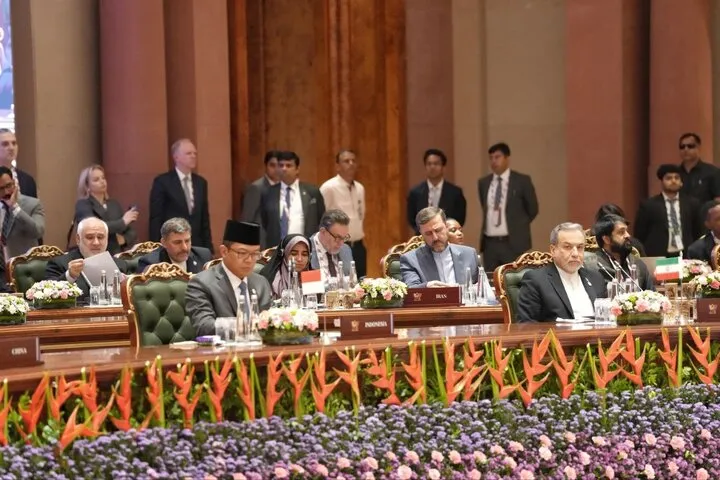
Tehran - BORNA - The text of the speech by Seyed Abbas Araghchi, the Honorable Foreign Minister of the Islamic Republic of Iran, on the second day of the BRICS Foreign Ministers' Meeting is as follows:
In the Name of God, the Most Compassionate, the Most Merciful
Mr. Chairman, Dear Colleagues;
Today, the world finds itself in an era of structural instability and a deep crisis of confidence. The structures governing the international order, which were designed in the post-World War II era, are no longer capable of responding to the realities of the 21st century. The gap between emerging powers and traditional decision-making structures not only threatens global stability but has also fueled widespread injustice in the distribution of power, wealth, and development opportunities.
Dear Colleagues;
What we are witnessing today in certain international institutions is not "multilateralism," but rather an attempt to maintain "unilateralism" under the guise of international laws. The instrumental use of laws, the imposition of unilateral sanctions, and the disregard for the rights and national sovereignty of countries are signs of a profound crisis in global governance. A system that leaves vital decisions for humanity to a limited group of countries and ignores the interests of developing countries has lost its legitimacy. This approach, based solely on power, not only fails to guarantee peace but is the root cause of regional and global tensions.
Within this framework, one cannot fail to speak of one of the main tools of global destabilization: unilateral sanctions. Today, sanctions have transformed from diplomatic tools into weapons for economic warfare and pressure on developing and independent societies. These actions, carried out in blatant violation of international laws, target not only governments but also the fundamental rights of human beings—including the right to life, the right to access health, food, and development. The sanctions imposed against nations are illegal actions that disrupt the global economic order, with objectives that go beyond conflict resolution and aim to create pressure for changing political behaviors. The Islamic Republic of Iran emphasizes that confronting this "economic terrorism" and establishing independent financial mechanisms within the framework of BRICS is an undeniable necessity for preserving the independence and national sovereignty of countries.
Ladies and Gentlemen;
Today's world is witnessing a return to the era of endless wars, naked violence, and extreme unilateralism. The ideal of peace, freedom, and respect for human rights and dignity has faded, replaced by pride in genocide, plunder, and aggression. The application of international law, international humanitarian law, and the UN Charter by powerful aggressors has been reduced to mere words and a lie to justify war and occupation. Most international organizations, especially the United Nations, have degraded themselves through unilateral bullying within the constraints of their law-making power.
Under such circumstances, the ideal of multilateralism of the Global South—upon which BRICS is founded and in which it is embodied—is more necessary and vital than ever for respecting international law, the UN Charter, and global governance. The members of BRICS consider themselves committed to implementing and defending the principles of this Charter.
The principle of the non-use of force, as a brilliant and central principle in the UN Charter and a human achievement born out of the bitter experiences of world wars, is now facing a serious challenge from the United States. The illegal and unilateral wars waged by this country have pushed the foundation of the international order—which was previously based on justice and multilateralism—to the brink of collapse, and have now entangled it with savagery and barbarism.
Therefore, the Islamic Republic of Iran emphasizes the necessity of fundamental reforms in international organizations, especially the United Nations Security Council. The reforms we envision are reforms for the "just distribution of power," not merely a change in the name or composition of members. We seek an order in which justice replaces power, national sovereignty remains the primary principle, the rights of all human beings are respected, and cultural and political diversity is accepted.
Distinguished Delegations;
The current political system requires a revision. Currently, the Security Council is a clear symbol of inefficiency and imbalance. A blatant example of this council's inefficiency is its silence in the face of the imposed and aggressive war by the United States and the Zionist regime against the Islamic Republic of Iran. In this war, women and children were systematically and purposefully targeted. These actions are a gross violation of the Four Geneva Conventions and clear examples of war crimes and crimes against humanity.
The most catastrophic example was the two-stage attack on the "Shahid Motahhari" girls' school in the city of Minab, during which 168 innocent individuals—including schoolgirls and schoolboys—were martyred during class hours and in their educational facility. The military aggression of the aggressors, which began precisely at 9:30 AM on Saturday, February 28, did not even give schools the chance to close and students to return to their homes. Immediately after the terrorist act against the Supreme Leader and the start of the military aggression, the Iranian government announced a nationwide closure of schools, but the aggressors did not give the children even half an hour to survive, targeting the Minab school with a second attack.
The attacks on Iran's critical infrastructure—including refineries, petrochemical complexes, bridges, railways, stadiums, cultural and historical centers, energy transmission lines, and important industrial facilities—are a continuation of this trend. This infrastructure consists of not just technical or economic facilities; they are the backbone of the daily lives of the people.
If today we remain silent in the face of the suffering of the Iranian people, in the face of the unjustly spilled blood of citizens, in the face of the anxiety of children in the schools of Minab, and in the face of attacks on infrastructure, or if we pass past it based on political considerations, tomorrow this cycle of violence and instability can move to any other part of the world. Defending Iran is defending a universal principle: that the security of no country should be built upon the ruins of the homes, schools, and vital infrastructure of another nation.
We call upon all governments and international organizations to stand with a clear and responsible voice against attacks on civilians and critical infrastructure in Iran, and to defend the rule of law, justice, and human dignity. The international community must set aside double standards and demonstrate that the life of a child in Minab is just as valuable as the life of a child anywhere else in the world.
Dear Colleagues;
Accordingly, reforming the Security Council is not a choice, but a necessity for the survival of the United Nations. We seek a council that has genuine representation from all continents and regions of the world, a council in which power is distributed with responsibility and justice, rather than solely serving the interests of certain abusive and aggressive powers.
In the meantime, the BRICS group, representing a large portion of the world's population and economy, possesses a unique potential to become the backbone of a genuine multilateralism. Within BRICS, we must work not to create a confrontational block, but to establish a strategic balance. Our cooperation in economic, financial, and technological fields can reduce dependence on monopolistic structures and provide a new space for independence and sustainable development. BRICS can be a model of cooperation based on mutual respect and shared benefit.
The time has come to move from "crisis management" to "structural management." We need an order in which peace is the product of justice, and stability is the result of universal participation. Let us utilize the capacities of BRICS to rebuild global governance and restore credibility to multilateralism.
Thank you for your attention.
End Article