Baghaei: Potential Understanding with U.S. Merely a Framework for Dialogue, Not a Final Agreement
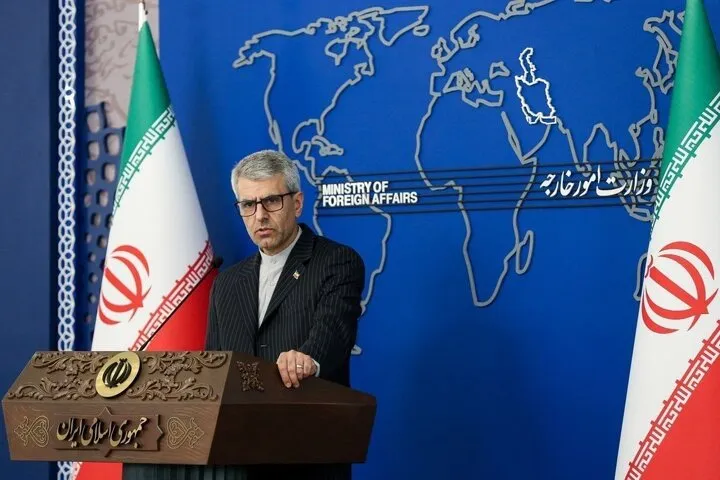
Tehran - BORNA - Esmaeil Baghaei, during a consultative meeting on Saturday, June 13, 2026, with media professionals of Hamedan Province, responded to a question regarding the Strait of Hormuz, stating: "Iran’s action to manage safe transit in the Strait of Hormuz is both in line with safeguarding the country's national interests and security, and in the direction of ensuring the public good of the international community. Naturally, the international community will also welcome any action that leads to guaranteeing the safety of transit in this strategic waterway."
He added: "The core of the matter is that the Islamic Republic of Iran, as a coastal state, in cooperation with Oman, can adopt the necessary measures to manage transit in the Strait of Hormuz. What mechanisms are defined in return for the services provided is a secondary issue, and the main issue is maintaining the security and safety of this important international passage."
Baghaei further pointed to the role of the media in the current situation and said: "You are our colleagues in advancing foreign policy goals, explaining the positions of the Islamic Republic of Iran, and neutralizing the enemy's hybrid and cognitive warfare against the Iranian nation. In the past year and a half, media has not merely been a tool for narrative, but has itself turned into an arena of war; a war designed and executed against the Islamic Republic of Iran, and from this perspective, the role of the media in explaining realities, describing events, and presenting the correct narrative of Iran’s oppression and authority is an irreplaceable role."
He continued: "The accurate and timely publication of news and information related to foreign policy is of great importance, but alongside that, presenting the first narrative based on reality is also very important. Today, we are faced with a kind of media chaos and turbulence in narratives, because many reports and news published by Western sources lack a foundation and are based on news-making and fabrication. Unfortunately, these materials are quickly translated and republished without any verification or review."
The Foreign Ministry Spokesperson clarified: "This situation both causes misunderstandings in public opinion and can help advance the enemy's psychological warfare. Therefore, it is necessary for the media to play the role of news gatekeeping. A simple review of many news data-x-items published by certain foreign media will reveal that they have no factual basis. In contrast, using official sources and information published by domestic authorities is of special importance."
Main Focus is on Ending the War and Tensions
Pointing to the continuous communication of the Ministry of Foreign Affairs with the media, he said: "In addition to the weekly press conference of the Foreign Ministry Spokesperson held every Monday, we have tried to explain foreign policy developments to public opinion through continuous engagement with the IRIB (Seda-va-Sima) and other media, and from here, I also invite the media friends of Hamedan Province to attend these meetings whenever they have the opportunity."
In another part of his speech, Baghaei referred to the process of negotiations and a potential understanding between Iran and the U.S., saying: "If we consider the timeline from April 8, 2026, and the beginning of Pakistan’s mediation process, we have passed through a path full of ups and downs over the past approximately two months. The main reason for these ups and downs has been that the American side has not followed a conventional negotiating model and has continuously changed its positions. Various American officials have raised contradictory and different views through the media, which has both made the work of mediators difficult and prolonged the negotiation process."
He added: "The Islamic Republic of Iran has the right, and indeed the duty, to pursue this diplomatic process with skepticism and caution. The experience of the past year and a half in interacting with the American side has shown that their promises and declared positions cannot be viewed with optimism. The American side has not only committed hostile actions against the Iranian nation during the negotiations, but has also repeatedly breached its promises in implementing its commitments prior to that. For this reason, every step in this path is taken with great precision, calculation, and foresight."
The Foreign Ministry Spokesperson noted: "The subjects under negotiation between Iran and the U.S. are very complex, but at the current stage, the main focus has been on ending the war and tensions. Given past experiences, it was decided not to enter into the details of nuclear issues at this stage, and the priority is placed on stopping the war on all fronts, including Lebanon."
Potential Understanding Between Iran and U.S. Not Considered a Final Agreement
He emphasized: "The potential understanding between Iran and the U.S. is by no means considered a final agreement. This understanding merely specifies a general framework for certain disputed issues, and its goal is to end the war and create the necessary ground for the continuation of talks. In the nuclear field as well, specialized negotiations and dialogues are scheduled to continue over a 60-day period; therefore, at this stage, there is no discussion about the details of nuclear issues."
Baghaei added: "The issue of lifting hostile U.S. actions against the shipping of the Islamic Republic of Iran, matters related to the Strait of Hormuz, and certain other issues are among the data-x-items discussed at this stage. Regarding the exact time of signing the understanding, one cannot speak with certainty. This event will not happen tomorrow, but its occurrence in the coming days is possible. However, given the unstable behavior of the opposing side, one must be cautious in any commentary regarding the future of the negotiations."
Pointing to the activities of the diplomatic missions of the Islamic Republic of Iran abroad, he said: "Iran’s embassies have had an active presence in the field of confronting the media and psychological war against the country in recent months, and their performance in this regard has been remarkable. Undoubtedly, we will use the acquired experiences to institutionalize and promote this process."
Regarding the guarantee for the implementation of the potential commitments of the opposing side, the Spokesperson stated: "We know very well that the opposing side does not have a good track record in implementing its commitments; hence, the necessary mechanisms to face potential bad faith have been predicted. Commitments will be adjusted in such a way that at any stage, if the opposing side refrains from implementing its commitments, the Islamic Republic of Iran can also take reciprocal measures."
Different Perspectives on Negotiations Must Be Heard
He continued: "In international relations, the most important guarantee is the power of countries. The Iranian nation is determined to defend its interests, dignity, and independence, and in recent months, it gave an unforgettable lesson to the enemies. The experience of this period will be a valuable asset for securing national interests in the arena of diplomacy."
In response to a question about different perspectives regarding the negotiations, Baghaei said: "We have a dynamic society, and it is natural that there are different views regarding foreign policy issues. As long as these differences of opinion do not lead to division and rifts in society, they can help make better decisions. All views must be heard so that decision-makers act with greater awareness of the issues."
In another part of his remarks, pointing to Iran’s relations with regional countries, he stated: "The Islamic Republic of Iran has never believed that it has a problem with its neighbors. We have no enmity with any country in the region, and neighbors are respected by us. What happened in recent months was the result of military aggression by the U.S. and the Zionist regime, as well as the failure of some countries to prevent the aggressors from using their territory and facilities against Iran."
Baghaei added: "Based on the established principles of international law, no country has the right to allow its soil, water, or airspace to be used for an attack against another country. The Islamic Republic of Iran had repeatedly warned about this issue before the war occurred. However, concurrent with defensive measures, we have always invited regional countries to cooperate for the formation of collective security based on mutual trust, and we continue to emphasize this policy."
Only Way to Create Security in Region is Ending Foreign Military Presence
He said: "We believe that the only way to create sustainable security in the region is ending the military presence of foreigners and the movement of regional countries toward shared and indigenous security mechanisms."
The Foreign Ministry Spokesperson also pointed to certain claims raised by American officials, stating: "American officials easily change their positions and make contradictory remarks. These cases are part of their psychological war and should not be the basis for analysis. The negotiation process is completely clear, the negotiating team is specified, and the mediators also have a clear role."
Criticizing the republication of certain unverified news in the media, he said: "In numerous cases, we have witnessed that domestic media were the first publishers of a news item, but that same news gained attention only when it was republished with the narrative of a Western media outlet. This approach needs a review, and the media must pay more attention to official domestic sources than before."
Regarding the follow-up of crimes committed against the Iranian people, including the incidents in Minab, Baghaei said: "Our first duty is the precise documentation of these crimes so that they can be used for any legal action in the future. Of course, experience has shown that many international bodies do not move in the path of implementing justice in practice as they should; an example of this is the manner of dealing with the crimes committed in Gaza."
He added: "Despite this, the Islamic Republic of Iran will not overlook any opportunity to register and follow up on these crimes. Holding specialized meetings, dispatching foreign journalists, continuous documentation, and utilizing various international capacities are part of the measures taken in this field."
Unfreezing of Iranian Nation's Assets Inseparable Part of Any Understanding
Regarding Lebanon, Baghaei stated: "Within the framework of the understandings reached, the issue of Lebanon has been considered as part of the process of ending the war, and efforts have been made to include the ceasefire in Lebanon within the framework of the agreements. Of course, given the track record of breach of promise by the opposing side, there will be numerous challenges along this path."
Regarding Iran’s frozen assets, he said: "The unfreezing of the Iranian nation’s assets will be an inseparable part of any understanding, and the Islamic Republic of Iran is determined to provide full access to these resources. The necessary mechanisms have also been predicted to achieve this goal."
In response to another regarding the positions of some Members of Parliament about the negotiations, pointing to the engagement between the government and the Islamic Consultative Assembly (Parliament), he said: "In the past two years, a very good connection has been established between the Ministry of Foreign Affairs and the Parliament, especially the National Security and Foreign Policy Commission, and the latest developments have been continuously explained to the representatives."
He also pointed to the performance of the diplomatic apparatus, stating: "The Ministry of Foreign Affairs must see itself at the level of the Iranian nation and the defenders of the homeland. Just as the armed forces bravely defended the country, the diplomatic apparatus also has the duty to defend national interests and the rights of the Iranian nation in the international arena. The coordination between the field (battlefield) and diplomacy has been unique in this period, and this cooperation played an important role in the country crossing difficult conditions."
Baghaei further pointed to the representative office of the Ministry of Foreign Affairs in Hamedan and said: "The Minister of Foreign Affairs has a special view of this office, and we hope its activities will be the source of lasting blessings and achievements for Hamedan Province. The Ministry of Foreign Affairs will also support the strengthening of this office and the best execution of its duties."
End Article