Will Journalists Fall Behind in the Race with artificial intelligence? When AI Become the New News Narrators
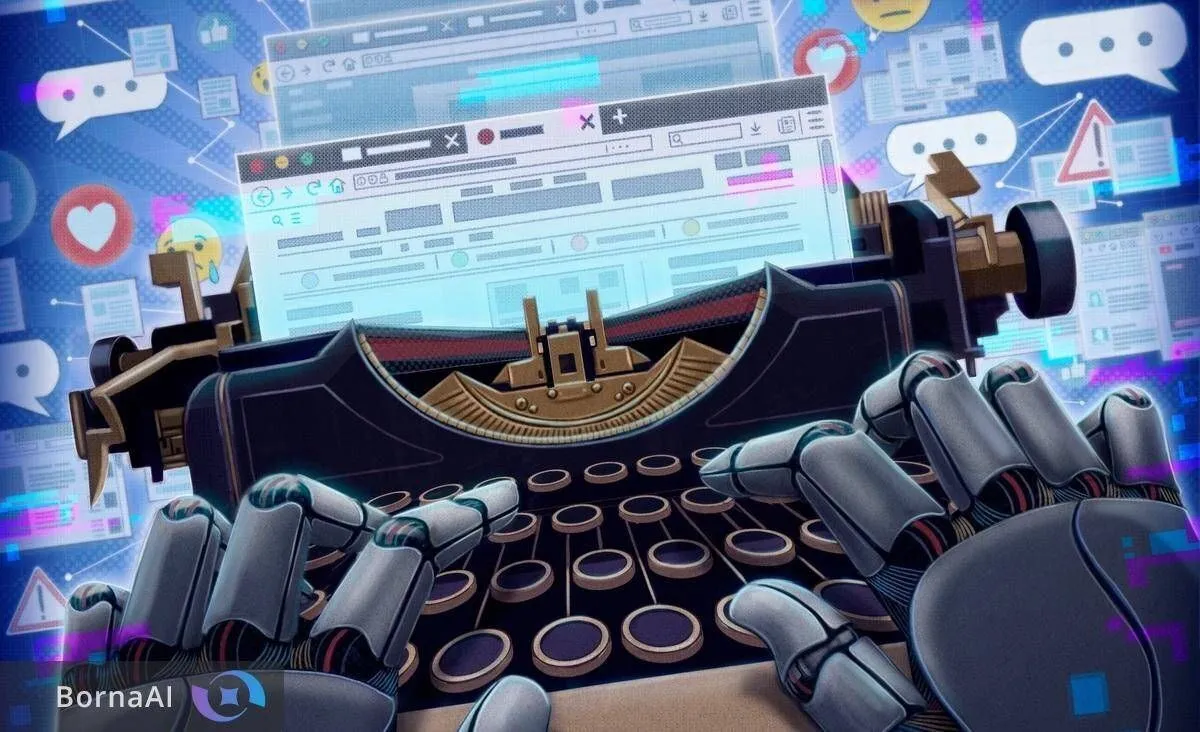
Tehran - BORNA - Artificial intelligence is currently applied in many aspects of journalism. Tools like ChatGPT for writing news, data analysts for trend extraction and event prediction, and AI systems for personalizing content and delivering news to users are common uses of this technology in the media. In fact, AI is rapidly becoming an essential tool for media organizations that aim to deliver information more quickly and effectively to their audiences.
Benefits of Using AI in the Media
- Speed and Accuracy in Content Production
One of the biggest advantages of AI in journalism is its ability to produce content quickly and with high accuracy. AI systems can rapidly analyze news, process data, and automatically generate news reports. This speed helps media organizations stay ahead of competitors and deliver news to audiences faster.
AI-driven content production can also reduce costs. For example, instead of journalists writing every single report, they can use AI systems to process and write news, freeing up time for analysis and research.
- Content Personalization
Another advantage of AI is its ability to personalize content based on user interests and behaviors. AI systems can analyze data and deliver relevant articles to different audiences, providing a unique experience of interacting with media.
- High Precision in Data Analysis
AI can process vast amounts of data and identify hidden patterns. This feature helps journalists gain a better understanding of events and situations, allowing them to produce more accurate and comprehensive reports.
Challenges and Drawbacks of Using AI in Journalism
- Job Threat for Journalists
One of the primary concerns about AI in the media is the potential replacement of journalists with this technology. AI systems can produce news content faster and more accurately, posing a threat to journalists' jobs. Particularly in breaking news or statistical reports, the role of humans may become minimal.
- Lack of Human Depth
Although AI can process data and write precise reports, it still cannot understand emotions or human experiences. Journalists, with their emotional insight and human perspectives, can tackle topics and create narratives that resonate emotionally with audiences. In this regard, some critics argue that AI-generated reports may lack human depth and emotional connection.
- Ethical Issues and Accuracy of Information
AI, especially language models like ChatGPT, may occasionally produce inaccurate or misleading information. In the context of journalism, this can be dangerous. Without human oversight, the spread of incorrect information could lead to misinformation, harming trust in media outlets.
- Legal and Accountability Issues
Using AI to generate content could lead to legal challenges. For example, if an AI-generated news report contains incorrect information or violates someone's privacy rights, who is held responsible? These questions remain unresolved and require legal examination.
Are Journalists Falling Behind AI?
In response to the question of whether AI can replace journalists, it can be said that while technology can take over many tasks performed by journalists. it will never fully replace humans. Journalism is a profession that requires creativity, critical thinking, and emotional understanding none of which can be fully replicated by AI.
Experts both domestically and internationally agree that the combination of human expertise with AI's processing power can result in higher-quality and more comprehensive content. For instance, Neil Patel, a digital marketing expert, states, "Using AI in content creation can help journalists focus more on analysis and research, instead of spending time writing, thus improving the quality of reports."
In this context, BORNA interviewed several journalists. Initially, Mahdieh Choupani, a technology journalist based in Iran, discussed the use of AI in the media industry, saying: "AI has infiltrated many areas and is increasingly becoming a threat to various jobs. However, this does not mean that all jobs will disappear or everyone will be unemployed. Certainly, some jobs will vanish, but new ones will be created in their place. One of the professions under threat is journalism."
She added: "Content production for news websites is usually dependent on data and information that already exists, such as news backgrounds or conducted interviews. Since AI, especially in data analysis, is highly efficient, it can easily replace journalists and produce more accurate and faster reports than them. With AI, we could access more powerful data that is much more comprehensive and accurate."
Choupani also mentioned: "My prediction is that while the journalism profession may not experience significant changes in our country in the near future, it will undoubtedly be greatly affected by the advancement of AI. If we can cover interviews and conversations using simple tools like online microphones, many of the traditional activities we perform will be reduced or even eliminated. In-depth reports that currently take a lot of time to write can easily be produced with AI tools like ChatGPT, eliminating the need to spend hours writing a report."
She concluded by saying: "This shift in journalism jobs is progressing rapidly, and as a technology journalist, I have benefited from AI, particularly ChatGPT, in my work. Just as media literacy is essential today, understanding AI and learning how to use it is becoming increasingly important. We must know how to leverage these tools, what information to feed them, and how to get optimal responses. The future of media professionals will undoubtedly be intertwined with new technologies, especially AI. While some journalistic jobs may be lost due to automation, new opportunities will emerge for journalists who can make use of these tools. Journalists must prepare themselves to use these tools effectively, not only to avoid falling behind AI but to strengthen their work with it."
End article

