Baghaei: Decision-making on Details of Any Potential Diplomatic Process is on the Agenda
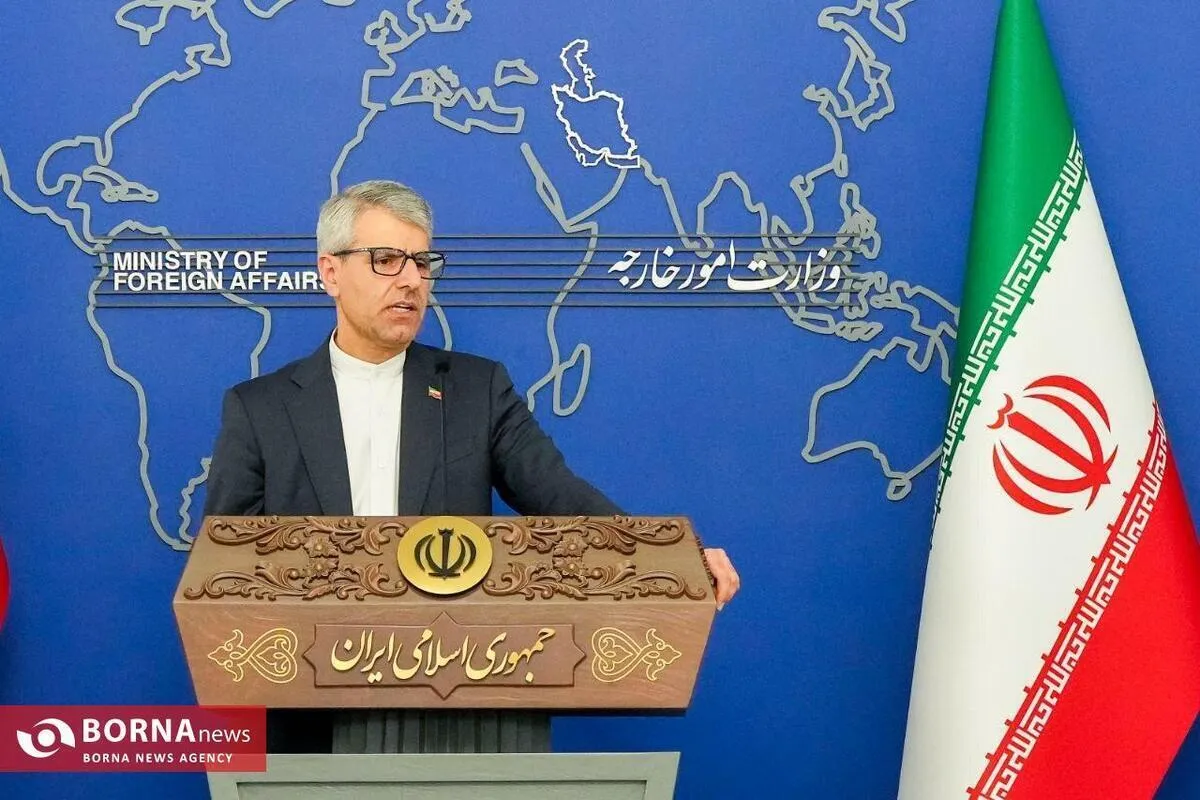
Tehran - BORNA - Esmaeil Baghaei began his press conference on Monday by congratulating the arrival of the "Ten-Day Dawn" (Dahe-ye Fajr) celebrations.
The Foreign Ministry Spokesperson noted: "In the past week, we witnessed continued instigation of tension by the U.S. and Israel in the region. On the other hand, Iran's diplomatic apparatus worked diligently and responsibly to secure the interests of the Iranian nation and safeguard regional peace and stability. Within this framework, we witnessed contacts between officials of the Islamic Republic and officials of regional countries, as well as several visits."
Summoning of EU Ambassadors to the Foreign Ministry
In response to a question regarding Iran's actions against the illegal move by the European Union to designate the Islamic Revolutionary Guard Corps (IRGC) as a terrorist organization, and whether European ambassadors had been summoned, he said: "Summoning the ambassadors is the minimum action that has been taken."
Referring to the condemnation statements by the Foreign Ministry and other relevant authorities regarding this EU move, he noted: "Yesterday and today, representatives of EU member states that have embassies in Tehran were summoned to the Foreign Ministry, and Iran's official protest was communicated to them in writing."
The Spokesperson added: "We are reviewing a set of measures in response to this EU action. Various options have been drafted and sent to decision-making bodies. I believe that in the coming days, decisions will be made regarding counter-measures against this unjustified and illegal move by the European Union." He continued: "The EU's action is not only an insult to the Iranian nation but was also a strategic mistake."
Potential Diplomatic Process and Negotiations
Regarding the issue of negotiations and recent news, including the latest tweet by the Secretary of the Supreme National Security Council, Baghaei said: "The Islamic Republic of Iran does not need to prove its seriousness and goodwill toward diplomacy, as this has clearly been demonstrated before."
He added: "In contrast, the opposing parties have committed numerous defaults and failures in this regard. Concerning the structure and framework of negotiations, various reviews are currently underway at this stage, and the different dimensions of the issue must be carefully evaluated."
Referring to the role of regional countries, he said: "Countries in the region, while concerned about current conditions, are sincerely trying to play a positive role. Within this framework, messages have been exchanged between the parties; however, some European countries, contrary to this approach, are practically moving in the direction of escalating tensions."
Baghaei clarified: "Currently, decision-making on the details of any potential diplomatic process is on the agenda, and it is hoped that in the coming days, we will reach a final conclusion on the manner of work and the mentioned frameworks, including what was raised in the tweet by the Secretary of the Supreme National Security Council."
Sanctions Removal as a Fundamental Priority
In response to another question suggesting that negotiations are currently aimed at "removing the shadow of war" and that issues like sanctions removal might not be high on the agenda, he emphasized: "No, that is not the case. The removal of sanctions is a fundamental priority for us. As the Foreign Minister indicated, the subject is nuclear negotiations, and our demand is the removal of oppressive sanctions."
Baghaei continued: "The issue we are currently facing also involves threats that must be addressed in a diplomatic process. However, as I mentioned, in any negotiation, the lifting of sanctions remains a fundamental priority for us."
The Epstein Case and Zionist Influence
Responding to a question regarding the mention of prominent names like the German Chancellor and the French President in the Epstein case, and the Zionist regime's exploitation of this file, he said: "I cannot provide an official opinion on this matter. At the media level, there have been discussions about the connections of Western politicians and statesmen to this case. There has been much talk about how this issue is being abused by certain circles, including the Zionist regime, to direct the decisions of certain politicians in the U.S. I am not in a position to confirm or deny it, but there is evidence that the Zionist regime has used such matters to exert influence on politicians in various countries."
No Changes Have Occurred in the Armed Forces' Drills
Regarding reports about Iran's military exercises and claims that these drills have been postponed or canceled, the Foreign Ministry Spokesperson said: "This is a matter for our military friends to comment on; however, given that some have tried to turn this into a source of tension in society, I must state—based on my conversations with our military friends—that no changes have occurred in the drills of the Armed Forces."
Testing and Preparation of IRGC Forces are Underway According to Schedule
He continued: "The Iranian Navy's exercise with the participation of China and Russia is an annual event, and so far, 6 to 7 rounds have been held in the northern Indian Ocean; this exercise is proceeding according to plan. The IRGC drill, which is essentially the testing and preparation of forces, is also being conducted according to the schedule. Generally, these drills are held regularly to enhance the country's military capabilities and in consideration of various scenarios that might occur for the country."
We are in the Decision-Making Stage
In response to another question regarding media reports suggesting that negotiations between Iran and the U.S. might be held in Turkey in the coming days and that these talks will be step-by-step, the Foreign Ministry Spokesperson said: "What is clear is that at this stage, we are reviewing both some generalities and details related to advancing this diplomatic process."
He added: "It is natural that regional countries have also intensified their 'good offices' (masaa'i-ye jamileh) in recent days. We are in the decision-making stage and have taken various angles of the issue into account."
Baghaei emphasized: "Time is important for us. In some stages of previous negotiations, we witnessed the opposing parties abusing the talks. For us, being able to reduce the oppressive sanctions as soon as possible will be a 'win,' and we have put the matter on the agenda with high precision and time-sensitivity, hoping to speak more about the details in the coming days."
Turkey Has Played a Positive and Constructive Role in Helping Reduce Regional Tensions
Regarding reports on the arrest of several Turkish citizens on charges of spying against Iran and anti-Iranian content in some Turkish media while officials of that country are trying to reduce tensions between Iran and the U.S., he said: "This issue was also questionable for us. Our relationship with Turkey is good and based on mutual respect, and the borders of the two countries have been borders of friendship and peace for years. In the last few days, Turkey has played a positive and constructive role in helping to reduce regional tensions."
He continued: "One must be careful and note that some parties do not tolerate closeness between regional countries and do not wish for collective regional efforts for the good of the region to bear fruit; they try to create disruption in this regard. We are certain that the Turkish government will handle these media atmospheres intelligently."
Do not worry about war at all
Continuing his conversation with reporters, in response to a question about the atmosphere of concern regarding the occurrence of war, he told the questioning reporter: "Do not worry at all."
Baghaei further noted: "As I mentioned before, we are in the decision-making stage regarding the details, and what is currently being raised in the media in this field is media speculation that cannot be confirmed."
News of a Trump-Pezeshkian Meeting is Media Speculation
In response to speculations about a meeting between Trump and Pezeshkian, he said: "These speculations regarding a conversation between the presidents of the two countries have been raised before. We have not said such a thing, and this is media speculation."
Iran's Agreement to Transfer Enriched Materials to a Third Country is Determined During Negotiations, Not Before
Regarding reports of Iran agreeing to transfer enriched materials to a third country, Baghaei said: "This is one of the issues that will be determined during the negotiation, not before it; in fact, the outcome of this matter will be clarified in the negotiation process, not before any negotiation takes place."
We are Realistic
In response to another question whether Iran is optimistic about negotiating with the U.S. following the recent tweet by Ali Larijani, Secretary of the Supreme National Security Council, he said: "We are realistic."
Regional Countries are Aware of the Consequences of Any U.S. Adventurism
Responding to a question regarding the Supreme Leader's remarks that any attack on Iran would turn into a regional war, and whether the Foreign Ministry has sent messages to regional countries, he said: "The fact that regional countries are collectively striving to prevent an increase in tension confirms that they are aware of the consequences of any U.S. adventurism in the region. they know that any war against Iran will be a war against the region, and they have realized over these two years that the winner of any conflict in the region is the Zionist regime."
Any Foreign Intervention in Iraq's Internal Affairs is Harmful
In response to an Iraqi media outlet regarding claims that the Leader of Iran sent a message to the Coordination Framework regarding the choice of Iraq's Prime Minister, he said: "What I can emphasize again is that Iraq's internal issues belong to that country. Iraqis can decide better than anyone on their political formations and the officials who should take responsibility. We emphasize that any foreign intervention, including recent U.S. intervention in Iraq's internal affairs, is harmful. We have always invited all parties to respect Iraq's national sovereignty and the processes that are the basis for decision-making according to Iraqi law."
In response a question egarding the contradiction of Europeans designating the IRGC as a terrorist group while claiming the path to negotiation is open, he said: "This is a clear contradiction. They cannot take confrontational and illegal actions against the interests of the Iranian nation on one hand, and simultaneously claim commitment to diplomacy; this is nothing but deliberate hypocrisy."
No Justification Can Be Found for the Contradictory Actions of the Europeans
Referring to the contradictory behavior of Europeans in recent years, he said: "We have witnessed this contradictory behavior, which has been against the interests of the Iranian nation, in the last one or two years on the nuclear issue and Iran's internal matters. No justification can be found for these actions, and it creates no belief in public opinion that European countries possess seriousness regarding diplomacy and their claims in this field."
"Seizure of Two Iranian Tankers by Malaysia" is Media Speculation
Regarding reports that Malaysia stopped two Iranian tankers, he noted: "I spoke with the relevant authorities in the Ministry of Petroleum, and they denied the essence of this matter; what has been raised is media speculation."
Iran Has Never Been Receptive to Any Ultimatum or Deadline
In response to whether the Americans have specified a deadline for an agreement, he told the reporter: "You know Iran; while Iran has sincerity and seriousness in diplomatic processes, it has never been receptive to any ultimatum or deadline, and such a thing cannot be confirmed."
We Have Close Contacts with Saudi Officials
Regarding reports attributed to Khalid bin Salman, the Saudi Defense Minister, suggesting Riyadh agrees with a U.S. military strike on Iran—which contradicts official Saudi positions—he said: "We have also seen these media reports. Iran and Saudi Arabia are two Muslim countries, and we have always had a positive suspicion (husn-e zan) toward our brothers in the region. We believe regional countries are well aware that any insecurity and adventurism has contagious consequences. The fact that regional countries are working to reduce tension confirms their consensus on this."
Baghaei added: "All countries must be careful; media abuse and the destructive role of third parties in regional issues is a real matter. It is not the case that we would evaluate a country's position based solely on a media report. We have close contacts with Saudi officials; Iran's ambassador in Riyadh is in close contact with Saudi officials, and yesterday a good conversation took place between the Foreign Ministers of Iran and Saudi Arabia. Simultaneously, we invite all regional countries to consider regional conditions with seriousness and precision and not allow parties who do not wish for the region's well-being to abuse the issues raised."
IRGC is the Guardian of Security and Stability in the Persian Gulf and Strait of Hormuz
Regarding CENTCOM’s warning to Iran about the use of live-fire in the upcoming exercise in the Strait of Hormuz—while simultaneously designating the IRGC as a terrorist group—the Foreign Ministry Spokesperson stated: "The act of declaring an entity terrorist and using labeling or insulting descriptions does not change the nature of an institution or a branch of the official Armed Forces of the Islamic Republic of Iran."
Baghaei noted: "The IRGC, as a part of the official institution and a component of the official Armed Forces of the Islamic Republic of Iran—an institution born from the heart of the Iranian nation—knows well how to perform its duties. As I mentioned, these exercises have been conducted regularly and normally every year, and this year they will be held in a completely professional manner to enhance the country's defensive capabilities." He added: "Fundamentally, the IRGC is the guardian of security and stability in the Persian Gulf and the Strait of Hormuz, and all parties must take this clear reality into account."
France’s Claims of Concern for Human Rights Lack Sincerity
In response to the French Foreign Minister’s remarks that Iran must accept the negotiation proposal and provide "fundamental concessions," Baghaei remarked: "The French Foreign Minister has made very strange and irrelevant comments. To understand the level of sincerity in their humanitarian claims, one should look at history. In the history of Algeria, one of the bitterest periods was French colonialism. Despite decades since Algeria's independence, the French are still unwilling to return the skulls and remains of those who fought and were martyred for their country's freedom. This reality shows that France's claims of concern for human rights, especially regarding Iran, lack sincerity."
He emphasized: "The nature of the French Foreign Minister’s remarks reflects a habitual tendency to act as a destructive element in any diplomatic process. France has no legal or moral standing to intervene or comment on any diplomatic process. We invite the French side to think about rebuilding their own position instead of interfering in Iran’s internal affairs or attempting to sabotage potential regional diplomatic processes."
The Lack of Economic Relations Stems from U.S. Sanctions, Not Iran
Regarding reports that Turkey might propose economic cooperation between Washington and Tehran to reduce tensions, Baghaei stated: "As Foreign Minister Araghchi mentioned, what prevents economic cooperation between Iran and the U.S. are the self-inflicted sanctions imposed by the United States. Under U.S. sanctions, any transaction between American and Iranian natural or legal persons is prohibited. Therefore, the lack of economic relations is a result of U.S. policies and sanctions, not Iran."
We Issued Necessary Warnings to Europe Regarding the IRGC Decision
On whether Tehran had consulted with EU members before the designation of the IRGC, Baghaei said: "Since this discussion emerged in recent months, as part of our diplomatic duty, we engaged with European parties. There was no legal basis for their action; it was entirely political. The primary sponsors of this decision acted for various motives—mainly to please the Zionist regime or certain warmongering circles in the U.S.—without accurately calculating the consequences. We issued the necessary warnings beforehand, but they ultimately made their decision and must naturally accept its consequences."
Any Conflict in the Region Will Confront the Entire Region with Serious Problems
Regarding Trump's rhetoric involving both threats and invitations to negotiate, Baghaei noted: "The primary solution is accurate information and clarifying the reality that any conflict in the region will confront the entire region with serious problems. As repeatedly emphasized, if a fire is ignited in one spot, it will be impossible to contain. We must be vigilant against campaigns in cyberspace and media designed to project weakness in the region and lure the U.S. into an endless conflict. These currents must be exposed as they focus solely on advancing the interests of the Zionist regime."
Parties Exist Using Every Tool to Entangle U.S. Policymakers in Endless Wars
Referring to Minister Araghchi’s statement that certain elements want to drag Trump into a war, Baghaei said: "It is quite clear; there are parties using every tool, including disinformation campaigns and falsehoods, to keep U.S. officials busy with endless wars in West Asia. These groups have no regard for regional interests or U.S. national interests. At the forefront of these parties is undoubtedly the Zionist regime, conspiring alongside warmongers in the U.S. and occasionally in Europe to drag America into a war that will benefit no one."
China and Russia Promptly Declared Opposition to U.S. Bullying Actions
Regarding expectations from Eastern partners, Baghaei stated: "Iran's relations with China and Russia are very good, with significant agreements covering various fields. China and Russia, both permanent members of the UN Security Council, promptly declared their opposition to U.S. bullying actions in their statements. The recent visit of Mr. Ali Larijani, Secretary of the Supreme National Security Council, to Russia was of particular importance. Both countries are fully aware of their responsibilities as strategic partners of Iran and permanent members of the Security Council."
Regional Countries Realize Any Escalation Against Iran Will Have Consequences Beyond Borders
On the numerous recent calls between regional leaders and Iran’s President and Foreign Minister, he said: "What we see is the formation of a shared understanding among regional countries regarding a threat directed at the region as a whole. They have well understood that any escalation against the Islamic Republic will have consequences beyond Iran's geographical borders. This is why they are striving to prevent escalation and help strengthen peace and security in West Asia."
Grossi Must Fulfill His Pending Responsibilities Since Last June
Responding to IAEA Director General Rafael Grossi’s claims of being unaware of Iran's nuclear facilities after recent strikes, Baghaei emphasized: "One must ask him: why is the Director General unaware? Before the attacks on June 12, you were fully aware, and inspectors visited regularly. The reason for this current 'unawareness' should be sought from the U.S., the Zionist regime, and the countries supporting their military aggression. The problem is that there is no protocol for inspecting peaceful nuclear facilities that have been attacked and damaged. Mr. Grossi should recall that Iran entered negotiations with goodwill, but the main problem was the abuse of the JCPOA dispute resolution mechanism by some countries. The Director General has so far avoided explicitly condemning these crimes and law-breaking actions. He should address the perpetrators of this situation rather than the party that was attacked."
The Basis for "Fair and Just" Negotiations is International Treaties
Regarding Donald Trump’s call for a "fair and just" deal, Baghaei stated: "It is perfectly clear to both sides what a fair agreement means. Our basis is international treaties and the principles of international law. Regarding the nuclear issue, Iran's right to peaceful nuclear energy is recognized in the relevant treaty; we are not going to create a new framework."
Zionist Regime Seeks a Weak, Unstable, and Chaotic Region
On the Zionist regime’s attempts to sabotage potential negotiations, Baghaei clarified: "The Zionist regime has shown it seeks a weak and unstable region. This increases the responsibility of regional countries and the international community to prevent the Zionist regime from entangling our region in endless and highly damaging conflicts. This is a global responsibility given the widespread violations of international law by this regime over the past 80 years."
Crimes Against '1948 Arabs' Indicate an Apartheid and Racist System
Regarding unprecedented protests by 1948 Arabs in Tel Aviv against discrimination and violence, Baghaei said: "These statistics show that the level of crimes against the so-called 1948 Arabs—with nearly 30 murders per month—indicates the existence of an apartheid and racist system in the occupied territories. This aligns with the 2022 report by the former UN Special Rapporteur. These developments cannot be separated from what is happening in the West Bank and Gaza, which systematically pursues the policy of erasing Palestine as a nation and an identity."
End Article