Kazem Jalali: Russia is Not Providing Military Support to Iran in Recent War
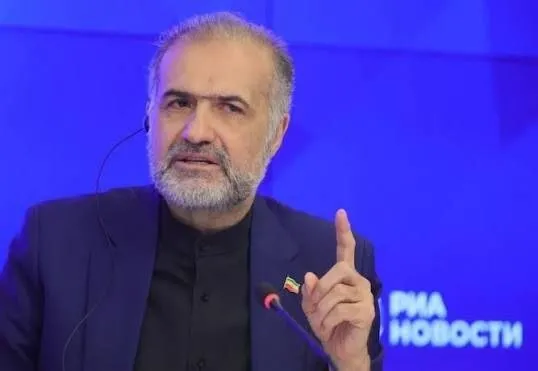
Tehran - BORNA - In an interview with the "Vedomosti" newspaper regarding Tehran's assessment of the causes and prospects of the war, as well as the possibility of ending it through diplomacy, Kazem Jalali, Ambassador Extraordinary and Plenipotentiary of the Islamic Republic of Iran to Moscow, said: "Trump and [Benjamin] Netanyahu, the Prime Minister of Israel, united for specific goals during the operations against Iran. They claimed they could conquer all of Iran within a few days and carry out regime change, even later suggesting they should participate in the process of choosing a new leader."
The Iranian Ambassador added: "In which of their goals did they succeed? Not even one. Their actions have led to further unity and gathering of the Iranian people, and our army has responded to their aggressive actions with higher morale. You should know that they will not succeed in the naval blockade either. Furthermore, they initially wanted to carry out regime change, but now they have reached a point where they [merely] want to open the Strait of Hormuz. This does not work. Now Trump is asked what the goal of attacking Iran was? He says: 'To open the Strait of Hormuz.' Fifty days ago, this strait was as open and free as possible. Why did he decide to attack Iran only for his current goal to be opening the Strait of Hormuz? It is ridiculous, and the naval blockade he announced is completely meaningless because we have an iron will to continue."
New Legal Regime for the Strait of Hormuz
Regarding the passage of ships from friendly countries through the strait and the possibility of receiving fees, he said: "We previously announced that a new legal regime will be applied to this strait. During the past 50 days, our leaders and officials have clearly specified all their tasks and issues. Based on the new legal regime applied to the strait, we will guarantee security; then, ships can pass freely. Iran guarantees safe passage. Based on this security and in accordance with the legal regime of the Strait of Hormuz, ships and vessels can pass."
Regarding the collection of fees for the passage of ships, Jalali said: "I cannot reveal the details. This still depends on our internal decision. The Iranian Parliament is considering various options to solve this issue."
Negotiation Prospects Depend on the Americans
Concerning the first round of negotiations in Islamabad and the role of Iran's Leader, the Ambassador said: "Naturally, when the Speaker of the Parliament, Mr. Mohammad Bagher Ghalibaf, was chosen as the lead negotiator in the April 11 meeting, it shows that the effort for negotiation was a popular and sovereign decision made at the highest level of our country, the most important level of which is the Supreme Leader, Ayatollah Mojtaba Khamenei."
He added: "After the Americans failed to achieve their pre-determined goals due to the unprecedented level of resistance from the Iranian people and our army, they deployed their mediators to ensure negotiations took place. We have always declared that we are ready to negotiate. But not negotiation from a position of power and threat. Not negotiation under pressure. The Americans [initially] presented a 15-point plan for negotiation. It was exactly at the time when we continued to repel their attacks, and we immediately rejected their 15-point plan. We could not agree to it. Then the Americans themselves, through mediators, suggested that Iran prepare a new plan. We prepared a 10-point plan. The mediators replied that the Americans agree with it and this plan can be the basis for negotiations. Therefore, based on our plan, we started and entered the negotiations. Of course, Pakistan played a key role here. As a friendly country with good intentions, it helped in holding the negotiations."
Failure of the First Islamabad Negotiations
Jalali said: "The Americans have become acquainted with our positions and conditions. They are convinced that they cannot break us through military action. We have clear red lines from which we will never retreat. As full members of the Non-Proliferation Treaty (NPT), we must exercise all our rights under this treaty, especially regarding peaceful nuclear energy. This is a fact. The future course of events, the prospects for negotiations, and reaching an agreement depend on the will of the Americans. If they want to implement the scenario Trump is talking about—namely, the blockade—they will later realize what they are facing. Trump said that 100% of U.S. demands must be met during the negotiations, but he is not satisfied even with a 95% level. This will not work."
He clarified: "Trump says we must agree with what he dictates through negotiation. This is not 'negotiation'; negotiation means reaching a fair compromise based on a win-win approach. What Trump did not achieve in the war, he can no longer achieve through negotiation."
Resolving the Conflict with Other Mediators
Regarding the role of other countries in mediating between Iran and the U.S., including Russia, the Ambassador said: "Russia is a friendly country. You know that we constantly consult with Russian officials. Our contacts continue at the highest levels. We are ready to listen to their initiatives and, of course, we will consider various initiatives from our Russian colleagues. We are grateful to the Russian Federation for the role it has played so far."
Europe’s Refusal to Accompany Trump
Regarding Europe, Jalali said: "We are truly convinced that Europe currently does not have the role it deserves in these events; they really haven't done their job correctly with the JCPOA. Remember, we even said we were ready to extend the agreement with the Europeans. They said Iranians must adhere to their commitments within the framework of this agreement. We said: 'Very well, we will fulfill our commitments. But what will you do? Why can't you lift the sanctions?' They replied that they really have no role in lifting the sanctions. Apparently, Iran had to coordinate this with the Americans. Therefore, we believe the Europeans do not have much of a role in this conflict. Honestly, we always wanted Europe to have a strong and independent position on these issues overall, because we deeply believe that a pluralistic system must operate at the global level. We always wanted Europe to play its independent role. We are currently witnessing a kind of autonomy in Europe regarding the war. We hope they can strengthen a minimum level of independence so as not to be led by the Americans as in the past."
Russian Intelligence and Military Assistance
The Ambassador continued regarding claims of Russian intelligence and military aid to Iran: "This is not true. The West has also acknowledged this, but it is not true. We had established specific contracts with our Russian colleagues in advance. These contracts, signed long before this war, are in no way related to this war. They are now being implemented and operationalized. But the idea that Russia specifically provides military support in this war is not true."
Zelensky's Visits and Ukraine's Military-Industrial Products
The senior Iranian diplomat in Russia said regarding the continuation of the Moscow-Kyiv conflict: "As before, we declare that we do not want conflict between any parties. We support lasting peace throughout the world. But we understand that Zelensky is constantly trying to blame someone else for his own weaknesses. Such trips will in no way affect our will."
Time for Extra-Regional Forces to Leave
Regarding the protests of regional countries against Iranian attacks during the recent war, Jalali said: "The Supreme Leader clearly stated in his last message: 'We favor good relations and good neighborliness with all neighboring countries.' But the Americans have long had a misconception. They wanted to station military bases in Iran's neighboring countries, thinking that if any attack was carried out from the soil of these countries, Iran would not attack them. Their 'shows' failed, and we warned all leaders of neighboring countries beforehand: 'We do not want to fight Arab countries. We want to develop bilateral relations. But we warn that if certain attacks and threats originate from bases stationed on your territories, we will retaliate against them.' What is the correct logic? They attack from the soil of neighboring countries, our citizens are killed! Are we supposed to sit idle and say it’s not their doing? No, we will not do that. Our actions were retaliatory and completely correct. Our path now lies in developing relations with neighboring countries. These actions and retaliatory attacks are not attacks on neighboring countries; these are attacks on U.S. military bases. Even the leaders of neighboring countries say these military bases are not in their hands and the Americans control them. Therefore, we did not attack neighbors; we attacked American bases."
He added: "Our neighbors might ask the Americans: 'Why couldn't you provide our security?' After all, their military bases have actually become a target and a threat to the region, and this incident allows for the creation of a new security architecture. Based on regional forces and capacities, it is necessary to create a new security architecture with the participation of countries. Currently, it is time for extra-regional forces to leave the region."
Trump's Efforts to Contain Oil Prices
The Iranian Ambassador regarding the U.S. permission for Iranian oil sales said: "Trump has done his best to contain the rise in oil prices. At the end of each week, the Americans raised the 'war rate' and intensified their attacks. Oil prices were rising, and they decided to ensure their tweets calmed the energy markets. We have also freed ourselves from restrictive measures. Although before that, our Oil Minister confirmed that we were already selling oil, and the sale price was determined by ourselves. The Americans wanted to play this plan for the energy markets in a psychological war."
Regarding the success of these plans, Jalali said: "This lie works to some extent. In our literature textbooks, there was such a story—about the lying shepherd and the wolves; to an extent, it works. But then people realize they are lying. Even if he tells the truth, people will no longer believe it. Trump is in this situation now. You see, in the United States itself, people laugh at this; it is ridiculous."
Rasht-Astara Railway Project
The Iranian Ambassador continued: "We agreed to sign the executive contract for these railway lines from April 1st of this year. They started a war, and because of this war, the implementation of this plan was not possible. But the war will not force us to postpone this plan. This year we hope to be able to put the executive part of the contract into operation."
He added: "The North-South Corridor is not limited to the mentioned railway route. This corridor has three branches—Eastern, Middle (Caspian), and Western. Trade and transit are carried out in all three branches. Of course, the weakening of logistics affects the trade process between the two countries, but we are trying to increase our resilience against geopolitical events and sanctions by diversifying trade routes. The Middle route—through the Caspian Sea—has great potential to promote this diversity, and we need joint investments to develop the fleet and infrastructure. Recent experience has shown that external pressure does not necessarily lead to a decrease in trade volume, but rather pushes it toward more stable and regional areas based on cooperation within frameworks such as the Eurasian Economic Union (EAEU)."
Nuclear Energy and Bushehr Plant
Regarding Iran's enrichment, Jalali said: "The Islamic Republic of Iran has the right to the peaceful use of nuclear energy under the NPT, and Iranian officials are planning the future within the framework of this treaty."
On the status of the Bushehr Nuclear Power Plant, he specified: "The Bushehr Nuclear Power Plant is operating thanks to the efforts of Iranian specialists and cooperation with Russian specialists, some of whom are still on site. Peaceful nuclear cooperation between the Islamic Republic of Iran and the Russian Federation has a 20-year prospect based on the strategic partnership agreement, and agreements regarding the Hormozgan nuclear plant and small power plants are considered for the long term."
Gas Cooperation
Regarding gas cooperation, Jalali stated: "The Azerbaijan route is currently the most realistic and ready option for developing exchanges and expanding gas transmission capacities. Due to the existence of communication infrastructure, operational experience, and geographical proximity, this route has a higher level of technical and political implementation and can serve as the main axis of energy cooperation between Iran and Russia in the form of tripartite or bilateral agreements."
He concluded: "Regarding the financing and implementation of the gas pipeline project, the most likely models are hybrid models—namely, the participation of large Russian energy companies along with bilateral settlement mechanisms or the use of national currencies."
End Article