Northern ports double essential imports share as Hormuz blockade reshapes Iran's trade
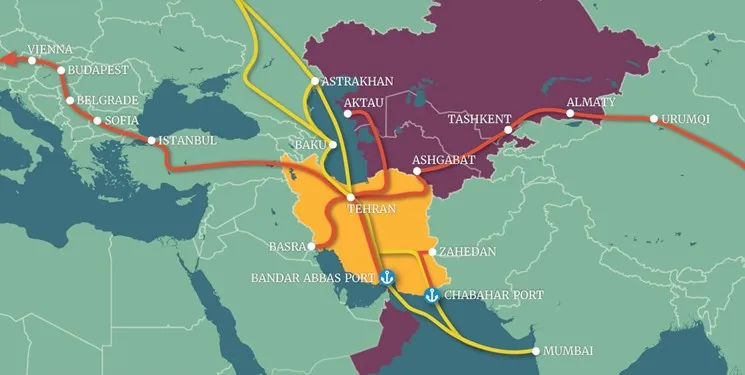
Tehran - BORNA - Due to the naval blockade in the Strait of Hormuz and ongoing conflicts in the area, vessel traffic has faced significant challenges, with some cargo owners currently unwilling to transit through the region. In response, over recent days, numerous officials and experts have discussed shifting trade from south to north, strengthening the country's eastern corridors, enhancing trade through northern ports, and reorganizing the country's logistics network to counter the naval blockade.
Experts believe that since the majority of imports, especially essential goods tied to the country's food security, have for years been supplied through southern ports, the government must adopt a decentralization approach and pursue land and maritime alternatives independent of the Strait of Hormuz. This would diversify the flow of essential goods under various conditions and reduce vulnerability during crises.
Some transport and logistics experts also believe that given the wartime constraints affecting southern ports and maritime transport, other modes of transport, including rail and road, can compensate for the limitations in a combined manner and take on part of imports and exports. Additionally, strengthening other existing corridors in the country, including those in the east, can support trade.
The head of the Iranian International Transport Companies Syndicate has stated in this regard that economic resilience cannot be achieved without an efficient, coordinated, and sustainable transport network. Countries that have managed to maintain their stability under complex regional and economic conditions have, above all, strengthened their logistics infrastructure and supply chain management capabilities.
The Minister of Transport and Urban Development recently addressed the US naval blockade, noting that with the cooperation of Parliament's Civil Commission, the process of goods entry and exit has been redefined. In this regard, the capacities of border terminals in the east and west, as well as the capacity of the country's northern ports, have been assessed to replace damaged routes.
Now, in line with the opportunity to shift trade from south to north, the managing director of Iran's Ports and Maritime Organization has announced an increase in the share of northern ports in importing essential goods.
According to Shakibi-Nasab, last year 82 percent of essential goods imports were carried out through the country's southern ports and 18 percent through northern ports. This year, northern ports have seen a 14 percentage point increase in their share of goods imports, so that from the first day of the year until May 20 (in the Iranian calendar), the share of northern ports reached 32 percent while southern ports accounted for 68 percent. Furthermore, from February 28 to May 20, despite attacks on ports and their surroundings, 23.3 million tons of goods were loaded and unloaded.
Iran's alternative trade routes: Breaking the blockade through land and sea
Beyond the immediate shift to northern ports, Iran has been systematically developing alternative trade corridors that fundamentally challenge the notion that the country can be effectively blockaded. Analysts point to three major alternative routes that bypass the Strait of Hormuz.
The Caspian Sea route has emerged as a critical northern gateway. Four Iranian ports along the Caspian Sea—Anzali, Caspian, and Amirabad among them—are now working around the clock to bring in wheat, corn, animal feed, sunflower oil, and other essential supplies. . The North-South Corridor links Russia with the Caspian Sea and Iran, offering an outlet entirely beyond the reach of the US naval blockade in the Persian Gulf. Trade volume between Iran and Russia in 2024 reached approximately 3.74 million tons, reflecting the growing importance of this route. The port of Amirabad alone has handled more than 3.25 million tons of essential goods, particularly grains and raw materials.
To the east, Iran has activated a land corridor with Pakistan that bypasses the Strait of Hormuz entirely. The newly activated corridor—based on a 2008 road transport agreement between Tehran and Islamabad—now links six land routes from Pakistan's key ports of Gwadar, Karachi, and Port Qasim to Iran's border crossings at Taftan and Gabd. The objective is to move goods from south to north without concern over US naval vessels or maritime restrictions . Analysts say this connection opens a new route for trade between Tehran, Beijing, and Central Asian countries, reducing pressure from maritime sanctions. Crucially, this corridor connects to China's $60 billion China-Pakistan Economic Corridor (CPEC), a 3,000-kilometer network linking western China to the Indian Ocean.
Oil exports by rail have also seen a dramatic expansion. While only one cargo train traveled weekly between Xi'an in central China and Tehran before the war, trains are now departing once every three or four days, with traffic along the railway completely booked in May, according to Bloomberg sources cited by the New York Post . Each train from Xi'an carries about 50 standard 40-foot containers, and goods traveling between the countries by rail through the Kazakhstan-Turkmenistan-Iran corridor have increased substantially. Hamid Hosseini, spokesman for Iran's oil exporters union, confirmed that exporting oil by rail has become viable.
The Jask terminal on the Sea of Oman provides another critical bypass option. Commissioned in 2021 and linked to the 1,000km Goreh-Jask pipeline, the terminal sits entirely outside the Strait of Hormuz, allowing tankers to load oil and access open waters without transiting the chokepoint. Data from analytics firm Vortexa showed that between April 13 and April 22, at least 34 tankers linked to Iran were able to bypass the US blockade, with at least 10.7 million barrels of Iranian crude passing through the Strait of Hormuz during that period, generating approximately $910 million in revenue. Iran's oil exports to China remained stable during this period, averaging 985,000 barrels per day in the first half of April despite the blockade.
Why Iran is not blockadable
From a geopolitical perspective, Iran's position is fundamentally different from that of a typical maritime nation. With over 3,700 miles of land borders with seven nations, as well as a 435-mile-long coastline along the Caspian Sea, Iran possesses multiple avenues for trade that exist entirely outside the reach of any naval blockade .
According to the International Transport Center (INSTC), Iran has three major alternative routes to its southern ports: Caspian Sea ports, the Armenian corridor, and the eastern axis.
A member of the Iran-Pakistan Chamber of Commerce has stated that Iran is now among the top three countries globally in terms of maritime transport capacity and is present in 8 to 9 important regional corridors, with potential annual maritime transport capacity of about 80 million tons of goods and transport links with 50 countries. Under this assessment, the likelihood of a naval blockade succeeding is very limited.
Experts acknowledge that while short-term disruptions are inevitable—and the southern ports will continue to face challenges as long as the blockade remains in place—Iran's long-term trajectory is toward reduced vulnerability. "Measures like trucking in goods from neighboring countries can compensate for blockade-related disruptions," Rosemary Kelanic, director of the Middle East Program at the Washington-based think tank Defense Priorities, told Radio Free Europe. "The possibilities for the Iranians to 'MacGyver' their way around Trump's blockade are endless because the country has thousands of miles of land border to work with".
The combination of the east-west corridor (connecting to China and Pakistan) and the north-south corridor (connecting to Russia and Central Asia) is expected to create a logistics triangle, upgrading Iran's role from a transit country to a regional hub. While experts stress that roads and railways will never fully replace ships, they note that in times of crisis or heightened military tensions in the Strait of Hormuz, these land routes can keep trade flowing. As one analysis concluded, the alternative routes "achieve a fragile balance sufficient for survival," and the future of this balance may depend as much on negotiation dynamics as on geography or economics alone.
End Article